The Community Reinvestment Act (CRA) is a US federal law that requires banks to meet the credit needs of all communities they serve, including low- and moderate-income (LMI) neighbourhoods. CRA exam ratings are public, and ratings below Satisfactory can block acquisitions, mergers, and branch expansion plans. That makes CRA documentation a strategic concern, not just a compliance task.
Most banks have strong systems for tracking the lending side of CRA performance. The qualitative side, community engagement activities and partnerships, is where many institutions still rely on spreadsheets and email. This page explains what CRA documentation actually requires, why generic tools fall short, and how purpose-built stakeholder relationship management (SRM) software helps banks demonstrate the work they're already doing.
What is the Community Reinvestment Act (CRA)?
The CRA was enacted by Congress in 1977 to combat redlining and promote equitable access to credit and financial services. Banks are required to demonstrate that they meet the credit needs of all geographic areas where they operate, with a particular focus on LMI tracts and borrowers.
Three federal regulators oversee CRA compliance:
- The Office of the Comptroller of the Currency (OCC)
- The Federal Deposit Insurance Corporation (FDIC)
- The Federal Reserve
Each agency conducts examinations on the banks it supervises. Exam findings produce a public CRA rating that follows the bank for years and influences regulatory approval of major business decisions.
How CRA performance is evaluated
Large banks are evaluated under a three-test framework, with each test contributing to a composite rating.
-
Lending Test (50%) assesses mortgage lending, small-business and small-farm lending, innovative or flexible lending practices, and community development (CD) loan origination.
-
Investment Test (25%) assesses qualified CD investments and charitable contributions, evaluated on dollar volume and qualitative factors.
-
Service Test (25%) assesses branch distribution in LMI places, branch openings and closings, innovative financial services for LMI populations, and CD services, including board service and financial services-related volunteer programs.
Composite ratings range from Outstanding to Satisfactory, Needs to Improve, or Substantial Noncompliance. Ratings below Satisfactory can impede acquisitions and mergers, and fair lending or consumer compliance violations can further lower CRA ratings.
What examiners look for in community engagement activities
Lending data is reported through standardized regulatory filings. Community engagement and CD activities are not. According to CrossCheck Compliance, an industry consultancy, community development work isn't filed through a standard annual form, but it is closely scrutinized during CRA examinations.
Examiners want to see a clear, documented record for each qualifying activity. For every CD activity, banks should be able to show:
- Who benefited (the LMI population, geography, or community served)
- Where it took place (assessment area and census tract)
- When it was delivered
- Why and how it meets a qualified community need
- Which qualifying organization was served, and what is its mission
- What skills did the bank employees use (skills-based hours often weigh more than general volunteering)
The principle most CRA practitioners recommend is to capture everything first and evaluate qualifying status later. Activities that don't get logged in real time tend to get forgotten, and CRA credit gets left on the table.
The four types of CD service activity worth tracking
Bank community engagement work usually falls into four buckets, all of which can qualify for CRA credit if properly documented:
- Skills-based volunteering like financial coaching, small business mentoring, and consulting for LMI-serving nonprofits
- Traditional hands-on volunteering, like food bank shifts and community cleanup events
- Board and committee service for qualifying community organizations
- Virtual or hybrid volunteering, including remote financial literacy classes and online office hours
For each, the data captured should include the organization's name and mission, the type of activity, the location or community served, and the hours volunteered.
Community of Influence (COI) relationships
A Community of Influence (COI) is a community-based nonprofit, advocate, or other stakeholder that a bank engages with as part of its CRA work. Tracking COI relationships means knowing who owns each relationship internally, what's been discussed, what commitments have been made, and how those commitments map to CD activity goals.

The documentation gap most banks face
Most CRA technology investments go toward managing lending data, including Home Mortgage Disclosure Act (HMDA) Loan Application Registers (LARs), small-business loan tracking, geocoding, and mapping. These tools are mature and necessary. They aren't built for the qualitative work of tracking community partnerships, meetings, and activities.
According to Benevity's 2025 State of Corporate Purpose report, 32% of large enterprises are now focused on volunteering activity that counts toward regulatory requirements. For banks subject to CRA, that means employee volunteer hours have moved from a "nice to have" CSR program to a documented compliance input. The systems most banks use to capture that work haven't caught up.
Common patterns we see at banks:
- A shared spreadsheet that the CRA officer updates monthly
- Email threads are scattered across multiple inboxes
- Word documents stored on individual laptops or shared drives
- Manual data pulls in the weeks before exam preparation
This setup creates three problems. First, activities get missed. CD Service Hours and partnership work that qualify for CRA credit aren't captured because there's no easy way to log them in real time. Second, audit trails are weak. Examiners want to see when something was logged, by whom, and what changed. Spreadsheets don't track that natively. Third, institutional memory disappears. When a community development officer leaves, years of relationship history can leave with them.

Why CSR, Compliance, and Community Development teams need shared records
In most banks, CRA-relevant work happens across three teams that don't share systems.
-
Corporate Social Responsibility (CSR) or Human Resources owns the employee volunteer program. They track who volunteered, where, and for how many hours.
-
Compliance owns the CRA exam preparation. They need a defensible record of community development activities that maps to the Lending, Investment, and Service Tests.
-
Community Development (CD) owns the bank's relationships with community organizations, LMI advocates, and partner nonprofits. They know who the COI partners are and what's been promised in meetings.
When these three teams work from separate spreadsheets and platforms, the bank loses CRA credit. A volunteer hour gets logged in the CSR system, but never makes it into the compliance record. Community partnerships are cultivated through community development, but volunteer participation isn't linked to it. A commitment made in a quarterly community meeting goes nowhere because no one owns the follow-through.
A shared system of record solves this. When CSR, Compliance, and Community Development all log activity into the same platform, with the same fields and the same tagging, exam preparation stops being a fire drill.

Why CRM tools don't fit CRA community engagement tracking
Customer relationship management (CRM) platforms like Salesforce are built for sales pipelines. They're designed around opportunities, deal stages, and revenue forecasting. CRA community engagement work is structurally different.
A CRA team isn't moving a community organization through a sales funnel. They're maintaining a long-term relationship with a stakeholder who may participate in dozens of activities over many years. They need to log meetings, capture commitments, track activity participation, and report on outcomes that map to specific CRA exam criteria. Generic CRM reporting doesn't produce that view, and CRM data models force CRA teams into workarounds that get messy fast.
CSR platforms like Benevity, YourCause, and Bonterra solve part of the problem. They handle employee volunteer hour tracking and donation matching well. What they don't do is track the bank's stakeholder relationships, meeting history, commitments, and engagement records over time. Those are different software categories solving different problems.

How stakeholder relationship management (SRM) software fills the gap
Stakeholder relationship management (SRM) software is purpose-built to track relationships, communications, and engagement activities with communities, organizations, and individuals. Where CRM tracks customers and deals, SRM tracks stakeholders and the work that happens with them over time.
For CRA documentation, an SRM gives a community development team:
- A central record of every COI organization and the staff relationships within it
- A complete log of meetings, calls, events, and outreach activities
- Commitment tracking, so promises made in community meetings get followed through on
- Team-wide visibility, so when a staff member leaves, the relationship history stays
- Reporting that can be filtered by assessment area, activity type, or qualifying criterion
That last point is what makes SRM useful for exam preparation. Instead of rebuilding the picture from scratch in the months before an exam, the data is already structured the way examiners want to see it.

How Jambo supports CRA community engagement documentation
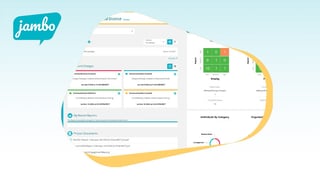
Jambo is an SRM platform built for stakeholder engagement teams in regulated industries. A major regional bank uses us to support CRA-related community engagement documentation across its assessment areas. They use Jambo to:
- Maintain a central database of COI partners with full contact and relationship history
- Log CD activities as they happen, capturing who benefited, where, when, the qualifying organization, and how the activity meets a CRA criterion
- Record commitments made in community meetings and assign internal ownership for follow-through
- Give the CSR, Compliance, and Community Development teams shared visibility into the same activity record
- Generate reports that map activity records to CRA exam categories
- Preserve institutional memory across staff transitions
Jambo data is stored and processed in the United States on AWS US infrastructure. We're ISO 27001:2022 and ISO 27017:2015 certified. We don't train AI models on customer data. For US bank procurement and information security teams, those facts matter.

What to look for in a CRA community engagement documentation tool
If your team is evaluating tools to support CRA documentation, a few criteria are worth checking carefully.
-
US data residency. Confirm that customer data is stored and processed in the United States. This matters for procurement, vendor risk reviews, and your own data governance posture.
-
Security certifications. ISO 27001 is the baseline. Ask about the audit scope and the issuance date.
-
Audit trail capability. Examiners want to see who logged what, when, and what changed. The system should track this natively, not as an afterthought.
-
Cross-team visibility. CSR, Compliance, and Community Development should all be able to work in the same platform without stepping on each other.
-
Ease of use for non-technical staff. Community development teams aren't data engineers. The tool needs to make logging activities fast enough that staff actually do it in real time.
-
Reporting flexibility. You should be able to filter and export records by assessment area, activity type, qualifying criterion, employee, and date range without needing engineering help.