Before embarking on a public consultation, UK government teams should carefully consider the following key questions to ensure an effective, purposeful process.
Table of Contents
Do you need to carry out a public consultation?
Check if the information you seek is already available to avoid duplication and consultation fatigue among stakeholders.
Do you understand what a public consultation involves?
It means actively engaging with those affected by your policy or project to gather their views and using this feedback to inform your decisions.
Have you considered the timing of your consultation?
Avoid running consultations during election periods unless the matter is urgent, in which case consult with relevant authorities for guidance.
What are the five main stages of public consultation?
.png?width=730&height=411&name=StagesOfPublicConsultation_Option1%20(1).png)
- Stage 1: Decide who to consult with
- Stage 2: Decide what to consult on
- Stage 3: Decide how to consult
- Stage 4: Start the consultation
- Stage 5: Evaluate and use the consultation results
Stage 1: Decide whom to consult with
.png?width=1920&height=1080&name=Decide-Whom-To-Consult-With_Design1%20(1).png)
The first stage of any effective public consultation is deciding who needs to be involved. This foundational step can help ensure meaningful engagement by identifying the diverse perspectives that need to be captured, especially those most affected by the outcomes of the consultation (i.e., the new policy, service changes, or planning decision).
At this stage, the key question is simple but critical: Who might be affected by, interested in, or able to influence the outcome of this consultation?
Identify affected and interested groups
Are you consulting the entire population, residents within a specific geographic area, or communities with a particular interest or lived experience? Different consultations require different audiences; clarity here helps avoid gaps and ensures relevance.
Map your stakeholders
Map potential groups to ensure all key voices are captured. Conducting thorough stakeholder mapping is an essential part of effective public consultation. UK public sector stakeholders generally fall into the following categories:
Partners:
- Community planning partnerships
- Voluntary and community sector organisations
- Public sector bodies
- Local businesses and contractors
Demographic groups:
- Women and men
- Children and young people
- Older people
- Families and carers
Underrepresented groups:
- Minority ethnic communities
- Religious and faith groups
- People facing geographical or digital barriers
- Low-income households
- Gypsy, Roma and Traveller (GRT) communities
Tip: Inclusive consultation goes beyond the "usual voices". Proactively consider how to reach and engage seldom-heard groups to ensure equitable participation among marginalised UK demographics.
Plan for inclusion from the outset
Inclusion should be central, not an afterthought. Your inclusion plan may impact:- Who you consult: Prioritise diverse and representative groups
- How you engage them: Tailor methods to suit specific needs and barriers
- The communication channels you use: Use accessible and varied formats to widen reach
For complex or large stakeholder groups, consider creating a stakeholder matrix. This tool helps you assess each group's level of influence, interest, and support, guiding engagement priorities.
Involve elected members
If the consultation is area-based or issue-specific, early involvement of relevant portfolio holders and ward councillors is essential. Councillors can:
- Provide local insight and intelligence
- Act as trusted intermediaries between government teams and the community
- Help answer questions and encourage participation
- Suggest additional relevant networks and groups to engage
- Leveraging their knowledge can significantly enhance the reach, relevance, and quality of your consultation.
Stage 2: Decide what to consult on
Once you've identified who to consult, the next critical step is deciding what to ask them. This stage centres on clarity of purpose, understanding what information you need, why you need it, and how best to collect it.
A clearly defined scope and well-designed questions help keep your consultation focused, achievable, and meaningful for both your team and consultees.
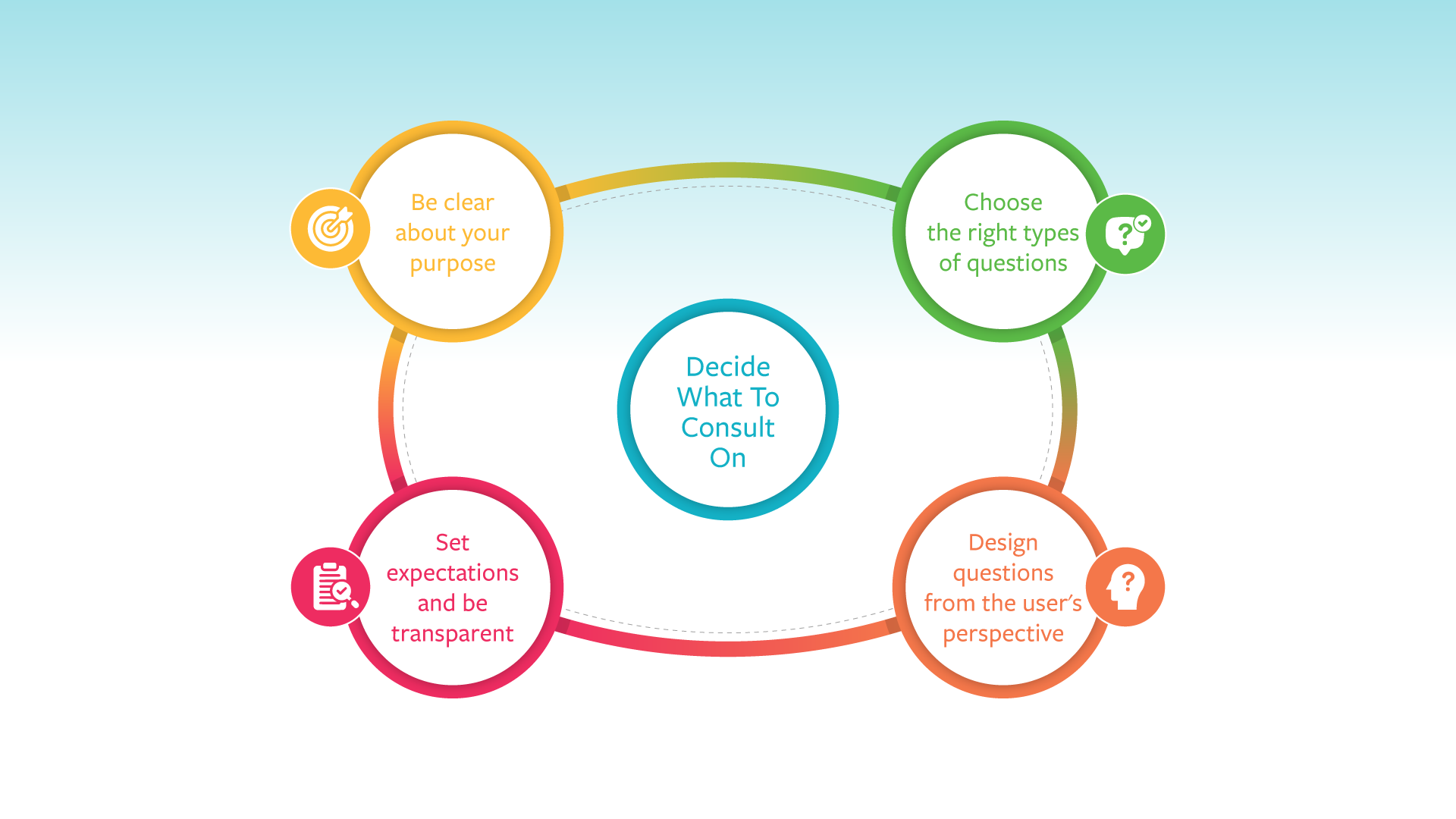
Be clear about your purpose
Start by reflecting on these key questions:
- Why are we consulting?
- What decisions or changes will this consultation inform?
- What specific information do we need to support those decisions?
Focus your consultation on a realistic, specific objective. Be transparent with consultees about what the consultation can and cannot influence, and how their input will be used to shape outcomes.
Also consider existing knowledge and previous consultations:
- What information do we already have?
- Have similar consultations been conducted before?
- What lessons or feedback emerged previously?
Very few consultations start from scratch, and building on past work avoids duplication and reduces consultation fatigue.
Choose the right types of questions
The information you need will guide your choice of question types and consultation methods. Most effective consultations use a mix of quantitative and qualitative questions.
Quantitative questions:
- How many?
- What?
- Where?
- Which?
- When?
Typically, closed and structured, these questions provide clear, measurable data, ideal for statistical analysis and presentation (numbers, charts, percentages).
Qualitative questions:
- Why?
- How?
Often open-ended, these questions explore views, experiences, and motivations. They deliver rich, detailed insight but require thoughtful analysis and interpretation.
When drafting questions, plan how responses will be collected, analysed, and reported.
Set expectations and be transparent
Transparency builds trust and shows consultees that their time and input are valued. Make sure you clearly explain:
- The reason for the consultation
- The options being considered, including their pros and cons
- The decision-making process and the evidence that will inform it
- How consultees' views will be considered and influence decisions
- How and when outcomes and next steps will be communicated, including any relevant appeal processes
Anticipate different expectations among stakeholders about the outcomes. Thinking about these potential perspectives in advance can help prevent misunderstandings.
Design questions from the user's perspective
Don't frame questions solely from a government viewpoint. Instead, consider:
- What do people want to share?
- What issues matter most to them?
Questions centred on consultees' priorities encourage honest, relevant, and valuable feedback.
Stage 3: Decide how to consult
By this stage, you should have a clear understanding of who to consult and what to ask. The next crucial decision is how to carry out the consultation. The methods you choose will directly influence who participates, the quality of feedback, and the inclusiveness of your public consultation.
There is no single "best" method or one-size-fits-all approach. Effective consultation typically involves a mix of methods, tailored to the service, issue, and audience you are engaging.
Design a fit-for-purpose consultation
When planning your consultation methods, keep these key principles in mind:
- Different people have different engagement preferences and needs
- A single consultation method (e.g., one focus group) is rarely sufficient on its own
- Each consultation should be custom-built around the specific issue
- Collaborate with other services or external agencies to run joint consultations where possible
- Try to build on an existing consultation activity instead of repeating previous work
- Aim to engage a representative sample of the local population
- Ensure proper timing to maximise participation
Common consultation methods
Below is an overview of commonly used public consultation methods:
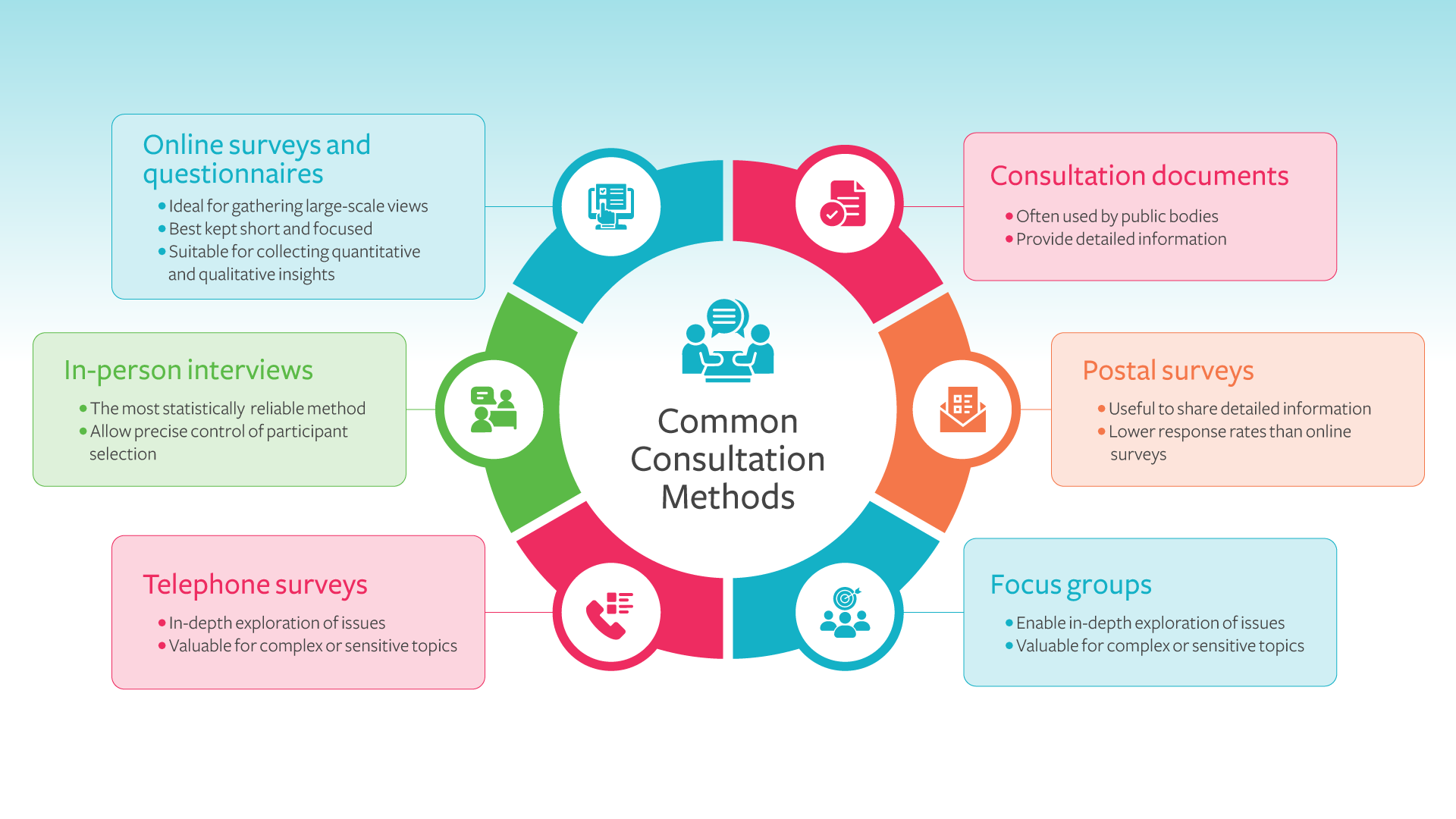
Online surveys and questionnaires
- Ideal for gathering large-scale views in a standardised format
- Best kept short and focused to encourage completion
- Suitable for collecting quantitative and qualitative insights
Consultation documents
- Often used by public bodies for formal engagement
- Provide detailed information and structured questions
Postal surveys
- Useful when you need to share detailed information as well as collect views
- Generally, have lower response rates than online surveys
Focus groups
- Enable in-depth exploration of issues from participants' perspectives
- Particularly valuable for complex or sensitive topics
Telephone surveys
- Enable in-depth exploration of issues from participants' perspectives
- Particularly valuable for complex or sensitive topics
In-person interviews
- Often, the most statistically reliable method
- Allow precise control of participant selection
Additional engagement approaches
Depending on your objectives, you may also want to consider:
- Creating leaflets or reports featuring statistics and success stories
- Advertisements in local media
- Community drop-in events or townhalls
- Mobile consultation units or kiosks located at community centres, libraries, or shopping centres
- Feedback boxes placed in libraries, council offices, or community centres for ongoing input collection
- Phone lines for suggestions or complaints
- Online webinars or virtual town halls to facilitate remote participation and live Q&A
- Social media engagement through targeted campaigns or interactive posts
- Text messaging (SMS) surveys for quick polls or reminders are beneficial for those with limited internet access
- Partnerships with local faith groups or cultural organisations to build trust and reach underrepresented communities
- Engagement through schools, youth clubs, or educational settings to reach young people and families
Choosing public consultation methods for different audiences
Understanding these preferences will help you choose the most effective mix of consultation tactics and methods to maximise engagement and inclusion:
- Most people prefer home-based methods like online surveys or information sent directly to them
- Public meetings tend to be less popular overall
- Higher-income groups are more likely to engage through panels or formal groups
- Lower-income groups may feel information-poor and are less inclined to participate without tailored support
- Younger people often prefer focus groups or street interviews
- Older people frequently engage better as part of neighbourhood groups
Stage 4: Start the consultation
At this stage, your planning moves into action. You're ready to launch your consultation and begin engaging with the public. How you conduct the public consultation is just as important as who you consult and what you ask.
To build trust and credibility, it's essential to follow clear standards and be transparent at every step.
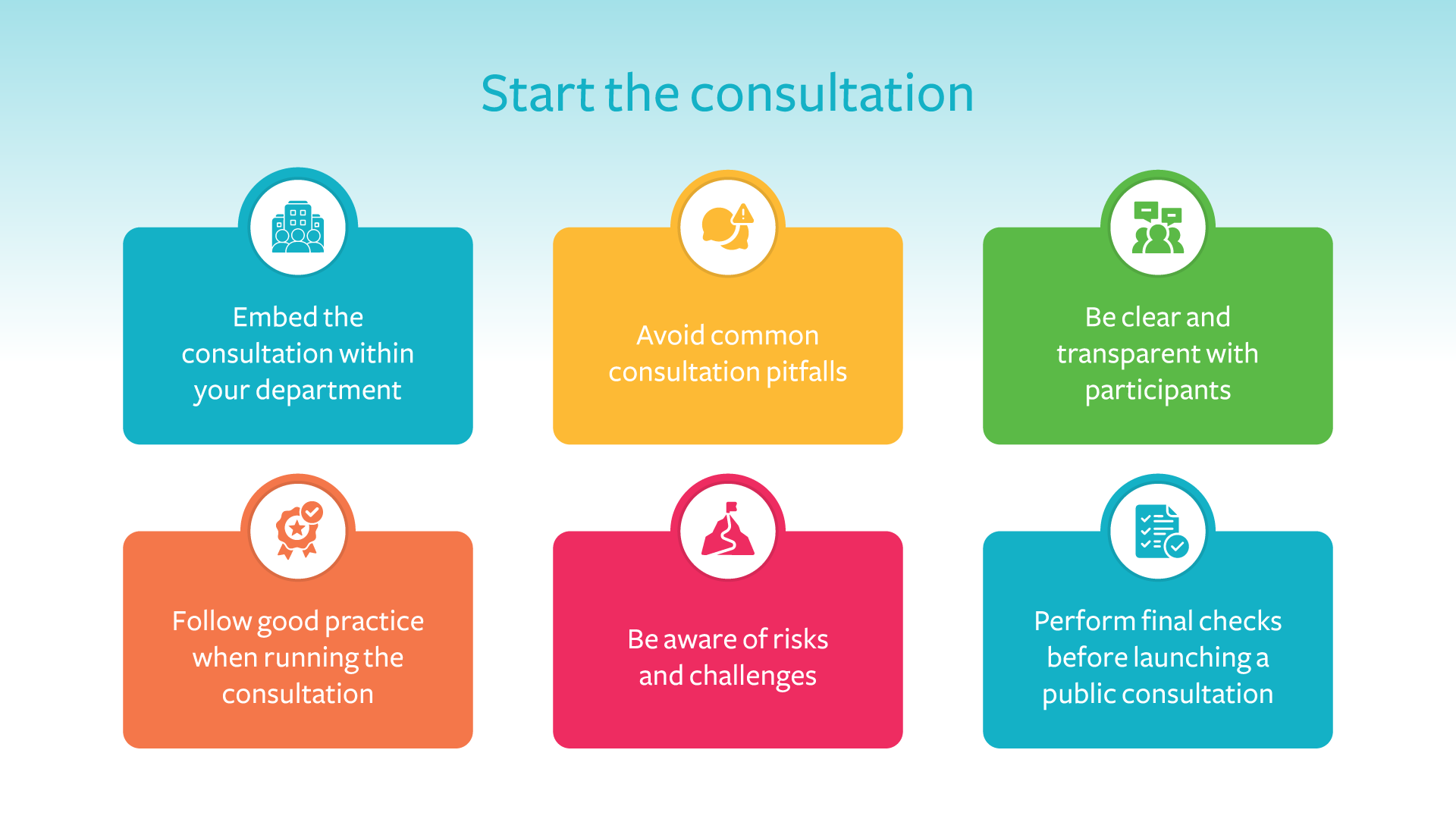
Embed the consultation within your department
Ensure your consultation is properly embedded across your team or department to guarantee accountability and avoid duplication across services.
Avoid common consultation pitfall
Past experiences often make people skeptical about consultations. Common concerns include:
- Not being told how their feedback will be used
- Never hearing about consultation outcomes
- Being consulted after decisions have been made
- Being asked the same questions repeatedly without a visible change
To avoid these pitfalls and "token" consultation, be honest, timely, and open. Consider involving a small group of users and non-users to help oversee the consultation process and ensure that feedback genuinely informs decision-making.
Be clear and transparent with participants
From the start, participants should clearly understand:
- Who is being consulted and why
- What decisions their input may influence
- Who will make those decisions
- When will decisions be taken?
- How and when the results will be communicated
- Whether anonymity will be maintained
- Who to contact if they have concerns about the process
Clear communication helps manage expectations and reassures participants that their input matters.
Follow good practice when running the consultation
To make your public consultation inclusive, accessible, fair, and effective:
- Use plain English and avoid jargon
- Avoid leading or ambiguous questions
- Offer a choice of consultation methods to accommodate different preferences
- Consider the needs of hard-to-reach and underrepresented groups
- Allow sufficient time for responses
- Plan how you will balance conflicting views fairly
- Decide whether to implement the public consultation in-house or hire an external agency (or a mix of both)
- Integrate the consultation into your wider service review and planning processes
Be aware of risks and challenges
Public consultations bring benefits but also risks and tensions. Key challenges to watch out for include:
- Raising unrealistic expectations about timelines for change
- Consulting on decisions that have effectively already been made
- Managing conflicting views among stakeholder groups
- Low participation without proactive engagement strategies
- Biased or unrepresentative responses if relying on a single feedback channel
Running meaningful public consultations often involves tension, and governments ultimately have final responsibility for balancing competing viewpoints in decision-making.
Final checks before launching a public consultation
Before you start, confirm:
- Who you're consulting and which views will carry the most weight
- That you're asking the right questions
- The appropriateness of your selected consultation methods
- Costs and available budget
- The decisions your consultation will influence and their timing
- Compliance of your consultation with data protection and privacy requirements (where are you going to store your data, and how do you control who has access to it?)
- Keep your consultation focused and proportionate. For broad or complex consultations, allow a minimum of six to twelve weeks to facilitate meaningful participation.
Stage 5: Evaluate and use the consultation results
Once your consultation has closed, the real value lies in how effectively you analyse, interpret, and act on the feedback. This stage is essential for informing decisions, maintaining public trust, and encouraging future participation.
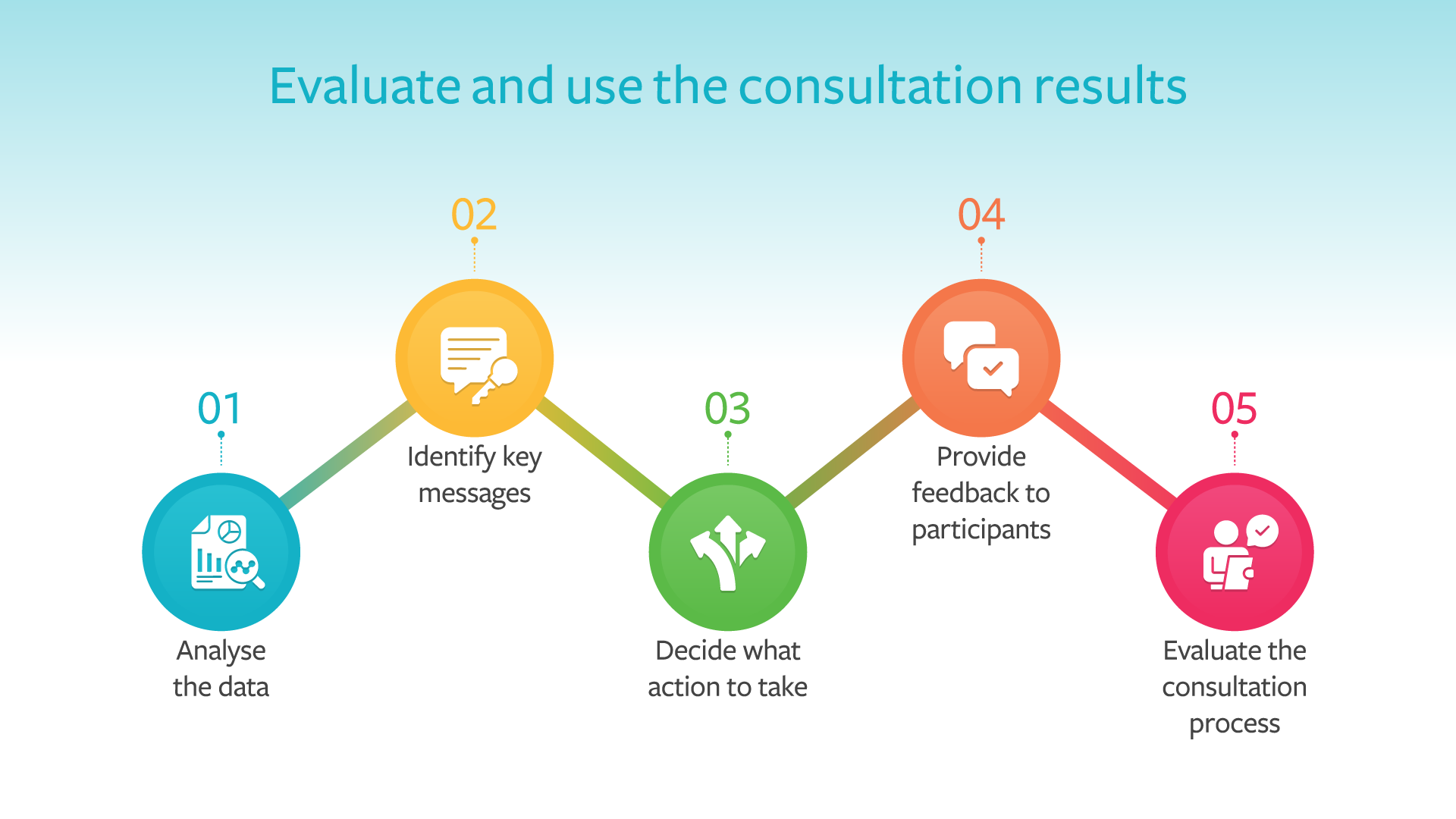
Analyse the data
Begin by analysing the raw data collected, tailoring your approach to the data type:
Quantitative data is generally the most straightforward to analyse. Responses can be converted into an electronic format using tools such as databases or stakeholder consultation software. These tools allow you to generate statistics, charts, and tables that clearly show patterns and trends.
Qualitative data, such as open-text responses, interviews, or focus group notes, requires a different approach. For simpler consultations, responses can be grouped under broad themes or headings to support analysis. More complex qualitative analysis may require specialist skills. Look for:
- Areas of agreement and disagreement
- Common themes and recurring concerns
- Unique insights and contextual information
The level of analytical expertise required will depend on the complexity of the consultation and the tools you have available. You should ensure you have access to the right analytical skills or stakeholder consultation software to interpret the results accurately.
Identify key messages
Once the data has been analysed, focus on identifying the core findings. Helpful questions to consider asking include:
The overall picture
- What are the main findings?
- Is there general satisfaction or dissatisfaction?
- Where is there consensus or divergence?
- Are patterns linked to geography, demographics, or protected characteristics?
Public priorities and expectations
- What matters most to people?
- How are we performing in these areas?
- What improvements are feasible?
- What lies beyond our control?
Benchmarking and trends
- Can results be compared with previous consultations?
- Are there benchmarks against other similar teams or departments?
- Are there clear trends over time?
- Do results align with regional or national trends?
Expectations
- What findings were expected?
- Which findings were unexpected?<
Decide what action to take
Be clear when producing public consultation results and recommendations:
- Identify quick wins achievable within existing budgets and timescales
- Explain honestly about changes that cannot be made immediately and why
- Clarify which findings require action and which do not
- Highlight areas needing further consultation, funding, or decisions<
- Recognise where improved communication alone could address concerns<
Remember, analysis and decision-making often take longer than anticipated, so allocate sufficient time.
Provide feedback to participants
Closing the feedback loop is vital for trust and ongoing engagement. People are far more likely to participate in public consultations again if they can see how their input has been used in decision-making.
A simple and effective feedback process includes:
- Thanking everyone who took part (for example, via your website or social media channels)
- Sharing a clear summary of responses and headline findings
- Explaining how the results will influence policy or services
- Using a simple "You Said, We Did" format to show responses and actions
- Publishing findings through appropriate insight or research channels
- Sharing detailed reports with councillors, committees, partners, and stakeholders
Tailor communication to different audiences. Residents may want summaries, while decision-makers may need full data and analysis.
Evaluate the consultation process
Finally, take time to conduct an internal review to evaluate how the public consultation went. This reflection helps build better, more effective consultation practices over time. Consider:
- What worked well and what didn't?
- What would you change next time, or what could be improved?
- What advice would you give to others planning a consultation?

How Jambo can support your public consultations
Public consultation information management doesn't have to be complex, fragmented, or time-consuming. Jambo is stakeholder consultation software designed to bring all your consultation data into a single, collaborative workspace, from planning and data collection through to analysis and reporting.
With Jambo, UK government teams can:
- Add all consultation responses and automatically create profiles for all participants
- Collaborate securely across departments and with third-party contributors, eliminating version chaos often seen with spreadsheets or disparate tools
- Capture insights clearly and consistently using your defined data fields
- Track decisions, actions, and outcomes with complete transparency
- Turn consultation feedback into evidence-based decisions faster with user-friendly custom dashboards and analytics
Whether you're running a small consultation focused on a service review or a wide-ranging public consultation, Jambo is here to help UK government teams streamline and enhance every stage of your consultation process. It enables you to move from listening to doing, with confidence, clarity and efficiency.
Find out how Jambo helped a UK government organisation save 350 hours a month on stakeholder reporting: