Most teams Googling "CRM for stakeholder management" don't yet know that a whole category of software was built precisely for this, and it's far more powerful than any CRM workaround.
This guide explains CRM for stakeholder management, why generic CRMs struggle with it, introduces you to a purpose-built category of software called stakeholder CRM software (also known as Stakeholder Relationship Management (SRM) or stakeholder management software), and shows you specifically how Jambo fills that role.
In this article:
- What is CRM stakeholder management?
- Why a traditional CRM falls short for stakeholders
- Five specific CRM gaps in stakeholder work
- What is stakeholder CRM software?
- CRM vs. stakeholder management software: feature comparison
- Who needs CRM stakeholder software?
- 5 signs your team has outgrown a CRM for stakeholder management
- How Jambo works as your stakeholder CRM
What is CRM stakeholder management, and why are people searching for it?
If you've landed on this page, you've probably been managing stakeholder relationships with a CRM, or you're about to evaluate one for that purpose. You're not alone, as lots of project teams, government agencies, energy developers, and community engagement professionals search for a "CRM for stakeholder management" every month. Customer Relationship Management (CRM) software is one of the most widely deployed categories of business software. Salesforce, HubSpot, Microsoft Dynamics, there's a good chance your organization already uses one of them.
So, when the need arises to track and manage relationships with communities, regulators, government bodies, Indigenous groups, or project-affected landowners, it makes perfect sense to ask: Can we just use our CRM for this? The honest answer is technically yes, practically no, and trying can expose your organization to serious risk. The reason? CRMs are engineered to sell. Stakeholder engagement is not selling. The objectives, relationships, workflows, and compliance requirements are fundamentally different.
Why a traditional CRM falls short for stakeholder management
Traditional CRMs such as Salesforce, HubSpot, and Microsoft Dynamics are exceptional tools for what they were designed to do: manage the customer journey, nurture leads through a sales pipeline, and drive revenue. Their entire architecture is built around one core question: How close is this contact to becoming a paying customer?
Stakeholder management asks entirely different questions:
- What concerns did certain community groups raise at last month's public hearing?
- What commitments have we made to this Rights Holder, and have they been fulfilled yet?
- Which stakeholders have the strongest influence over our project approval, and what's their current sentiment?
- How do we produce a report that will satisfy a regulatory body's requirement to demonstrate adequate engagement?
- A CRM can't answer these questions cleanly, at least not without lengthy and expensive customization that may still yield a compromised result.
The architectural mismatch
A CRM manages one-to-one relationships along a linear sales journey. A contact enters as a lead and progresses toward becoming a customer. Every feature, from deal stage management to lead scoring, is built around this linear model.
Stakeholder management, by contrast, involves one-to-many and many-to-many relationships that don't follow a linear path. A single community stakeholder might be linked to dozens of issues, commitments, and projects simultaneously. An organization, such as a local council, might contain 40 individual contacts, each with their own engagement history and other personal roles or responsibilities, and any interaction with one contact might affect the organization's overall sentiment.
You also need to be able to track and manage engagement with everyone based on their role at the time of the engagement. Many people wear many hats, and that is a key requirement for stakeholder engagement management. CRMs were not designed for this complexity.
The real cost of forcing a CRM: Organizations that try to use CRMs for stakeholder management typically spend months customizing fields and processes, but still lack effective commitment tracking and issue resolution timelines, struggle to produce meaningful engagement update reports, and risk data gaps and security breaches when contractors or temporary staff use the system inconsistently.

Five specific CRM gaps in stakeholder work
- No commitment tracking: In stakeholder engagement, promises made to stakeholders, communities, or regulators must be tracked through to resolution. CRMs track deals, not commitments.
- No issue and feedback management: Stakeholder concerns must be logged, prioritized, assigned, and followed to resolution. This workflow doesn't exist natively in sales CRMs.
- No sentiment analysis designed for engagement: CRM sentiment tools are built for customer satisfaction scoring, not for understanding how a stakeholder or community's mood toward a project shifts over time.
- No compliance-ready reporting: Regulatory bodies, environmental assessments, and government oversight agencies require specific engagement reports. Generic CRM reporting isn't built for this and will require a lot of copying and pasting, as well as external reporting tools, to produce something that can be compiled out of the box in a stakeholder management CRM.
- No concept of stakeholder influence or classification: An engagement strategy depends on knowing whether a stakeholder is a supporter, a neutral party, or an opponent and how much influence they carry. CRMs track leads; they don't map power dynamics.
What is stakeholder CRM software?
Stakeholder CRM software, also called Stakeholder Relationship Management (SRM) software or stakeholder management software, is a purpose-built platform that does for community and stakeholder engagement what CRMs do for sales and marketing: it centralizes data, speeds up communication record creation, surfaces trends and risks in engagement projects, and produces comprehensive reports on demand.
Think of it as a CRM for stakeholder management but rebuilt from the ground up with the right DNA. Instead of deal stages, it has engagement history timelines. Instead of lead scoring, it has sentiment tracking. Instead of sales forecasts, it has commitment registers and issue resolution dashboards.
The key distinction is objective:
- A CRM's objective is to maximize revenue by converting and retaining customers.
- The objective of stakeholder CRM software is to reduce risk and build trust by ensuring that every stakeholder is heard, every commitment is kept, and that data informs every engagement decision.
Learn more about stakeholder management software →
CRM vs. stakeholder CRM software: feature comparison
The table below shows exactly where a traditional CRM and dedicated stakeholder CRM software diverge and where they overlap.
| Features | CRM | Stakeholder CRM software (e.g. Jambo) |
| Contact and organization profiles | Yes | Yes, with stakeholder-specific fields (interests, concerns, influence level) |
| Communication history | Yes, sales-focused | Yes, engagement-focused, with Outlook integration and project email |
| Sales pipeline management | Core feature | Not applicable |
| Issue and feedback management | Not built-in | Full issue timeline, priority tracking, resolution workflows |
| Stakeholder engagement reporting | Requires significant customization | Pre-built and custom reports in PDF/CSV formats, in seconds |
| Commitment tracking | Not built-in | Track promises made, recurring commitments, and resolution |
| Sentiment analysis | Customer satisfaction | Secure AI-powered sentiment analysis per communication record, filterable and reportable |
| Geospatial / mapping tools | Rarely available | Map contacts, define project boundaries, and easily integrate with Esri ArcGIS Pro data |
Discover other stakeholder engagement tools your organization might be missing out on →
Who needs stakeholder CRM software?
You might assume this software category is niche. In reality, any organization that manages relationships with people outside its customer base and is accountable for those relationships is a candidate for stakeholder CRM software.
Roles and teams that benefit most:
- Stakeholder engagement managers and community relations leads
- Public affairs and government relations teams
- Environmental, Social and Governance (ESG) and sustainability officers
- Indigenous and Tribal relations specialists
- Regulatory and compliance professionals
- Project managers running multi-stakeholder infrastructure or resource development projects
If your team is responsible for managing trust with people who aren't your customers, and you need to prove that engagement was handled professionally, then stakeholder CRM software is your category.
5 signs your team has outgrown a CRM for stakeholder management
- Your CRM reports don't answer regulatory questions: When a regulator asks for a summary of all community engagement over the past 12 months, your CRM report requires hours of manual copying, pasting, and cleanup before it's usable.
- Commitments made to stakeholders get lost: You've promised something to someone, but there's no systematic way to track whether the promise has been fulfilled, especially if the promise was made by someone who no longer works on the project.
- Contractors can't safely access your system: either your CRM gives them access to everything, or it gives them access to nothing. You need project-level permissions that allow contractors to contribute without viewing sensitive data.
- You can't tell why stakeholders are dissatisfied: You know some community members are unhappy, but your CRM offers no way to visualize sentiment trends across a stakeholder base. The real picture is often obscured when there's no way to visually view the data geographically.
- Cross-project stakeholders create chaos: When a stakeholder appears in multiple projects, keeping their data consistent across your CRM requires manual effort, and errors creep in.

How Jambo works as your stakeholder CRM
Jambo is trusted by governments, energy developers, mining companies, infrastructure development partners, and healthcare organizations. It provides everything a CRM provides for customer management, and significantly more, tailored to the complex, regulated world of stakeholder engagement and consultation.
Here's a breakdown of Jambo's core features and why they matter for stakeholder management teams:
- Stakeholder profiles: Build rich profiles for every individual, organization, community, or location with contact details, interests, concerns, and a full engagement history that auto-updates with every record added.
- Communication records: Log every interaction, including emails, calls, meetings, and site visits. Use the free Jambo for Outlook add-in or BCC your Jambo project email address to automatically capture emails.
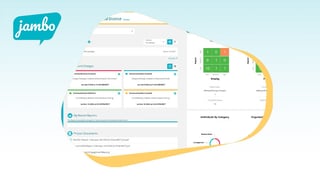
- Issue and feedback management: Log stakeholder concerns, assign priority levels, track progress through an issue timeline, and ensure no complaint falls through the cracks.
- Commitment tracking: Record every promise made to a stakeholder or community. Set recurring commitments, assign owners, and track resolution, all with a clear audit trail.
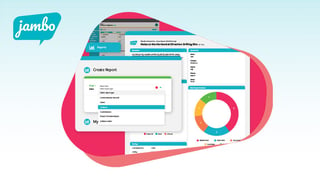
- Instant reporting: Generate detailed or summarized engagement-focused reports in seconds in PDF or CSV formats. Pre-built report templates are available, or build your own with custom filters.
- AI Sentiment and AI Summarize: Jambo Secure AI tools automatically analyze communication notes to assign positive, neutral, or negative sentiment, and summarize long records and detailed raw communication records into clear, concise summaries in a single click.
- Maps and geospatial tools: Map stakeholders by location, define project boundaries, identify engagement hotspots, and integrate with Esri ArcGIS Pro for advanced geospatial analysis.
- Shared calendar: A team-wide calendar of planned engagements, campaigns, commitments, and tasks so teams stay coordinated and proactive, not reactive.
- Enterprise security: ISO 27001 and ISO 27017 certified, hosted on SOC-2 certified AWS, with SSO, role-based permissions, audit trails, and GDPR compliance built in.
- Integration with your existing tools: Jambo doesn't require you to abandon your existing tech stack. It integrates with Outlook, Esri (via a free add-in), and 7,000+ apps via Zapier. A public API can connect Jambo to your enterprise systems.

Ready to replace your CRM workaround?
If your team manages stakeholders, not customers, you deserve software that was built for you. Discover why leading organizations trust Jambo as their dedicated stakeholder management CRM, purpose-built for stakeholder engagement, not sales.