Keeping stakeholders informed is one of those things that sounds straightforward until a project is underway. Then the questions start stacking up: How often? Through which channel? With how much detail? Who's responsible for what?
This guide covers what it means to keep stakeholders informed, why it matters, how to do it well across different situations, and what it looks like in practice for government teams, infrastructure projects, and engagement-heavy organizations.
Table of Contents
What does it mean to keep stakeholders informed?
Keeping stakeholders informed means making sure the right people receive accurate, timely, and relevant information about decisions, progress, and changes that affect them. In addition to sending updates, it includes listening, responding to concerns, and closing the feedback loop so stakeholders can see how their feedback shaped decisions.
"Inform" is also one of the five classic levels of participation, alongside consult, involve, collaborate, and empower. At the inform level, communication is mostly one-way. Stakeholders at this level have low to moderate interest and limited influence on decision-making, but they still need access to accurate information. This might include the public receiving project updates through a website or newsletter, or regulators receiving required compliance disclosures.
Understanding where each stakeholder sits within this framework is the foundation of any effective communication approach.
Learn more about stakeholder communication in this in-depth guide →
Why is it important to keep stakeholders informed?
Teams that communicate proactively with stakeholders outperform those that communicate reactively. Here's why the importance of keeping stakeholders informed is hard to overstate.
1. Builds trust and reduces project risks
When stakeholders consistently receive accurate, honest updates, they're more likely to trust your team when difficult decisions need to be made. Also, sharing information proactively means concerns get raised early, before they become formal complaints or legal challenges.
2. Improves your decisions
The more diverse perspectives you gather through stakeholder engagement, the better your decisions tend to be. A transportation project that consults only residents, for example, may miss critical input from commuters, school communities, and transit agencies who could identify design gaps that residents never mentioned.
3. Satisfies regulatory requirements
Environmental assessments, planning applications, Indigenous consultation requirements, and frameworks such as Free, Prior, and Informed Consent (FPIC) all entail explicit communication obligations. Meeting them protects your organization from compliance failures.
4. Maintains your social license to operate
Particularly for natural resource, energy, and infrastructure projects, regulatory approval is only part of what you need. Ongoing, respectful communication with host communities is how organizations earn and maintain community acceptance, enabling them to operate long-term.
Explore why it's important to build and strengthen stakeholder relationships→
The stakeholder matrix: whom to keep informed and at what level
A stakeholder matrix is a visual tool for organizing stakeholders by their level of interest and influence. It's the most widely used framework for keeping informed stakeholders engaged at the right level.
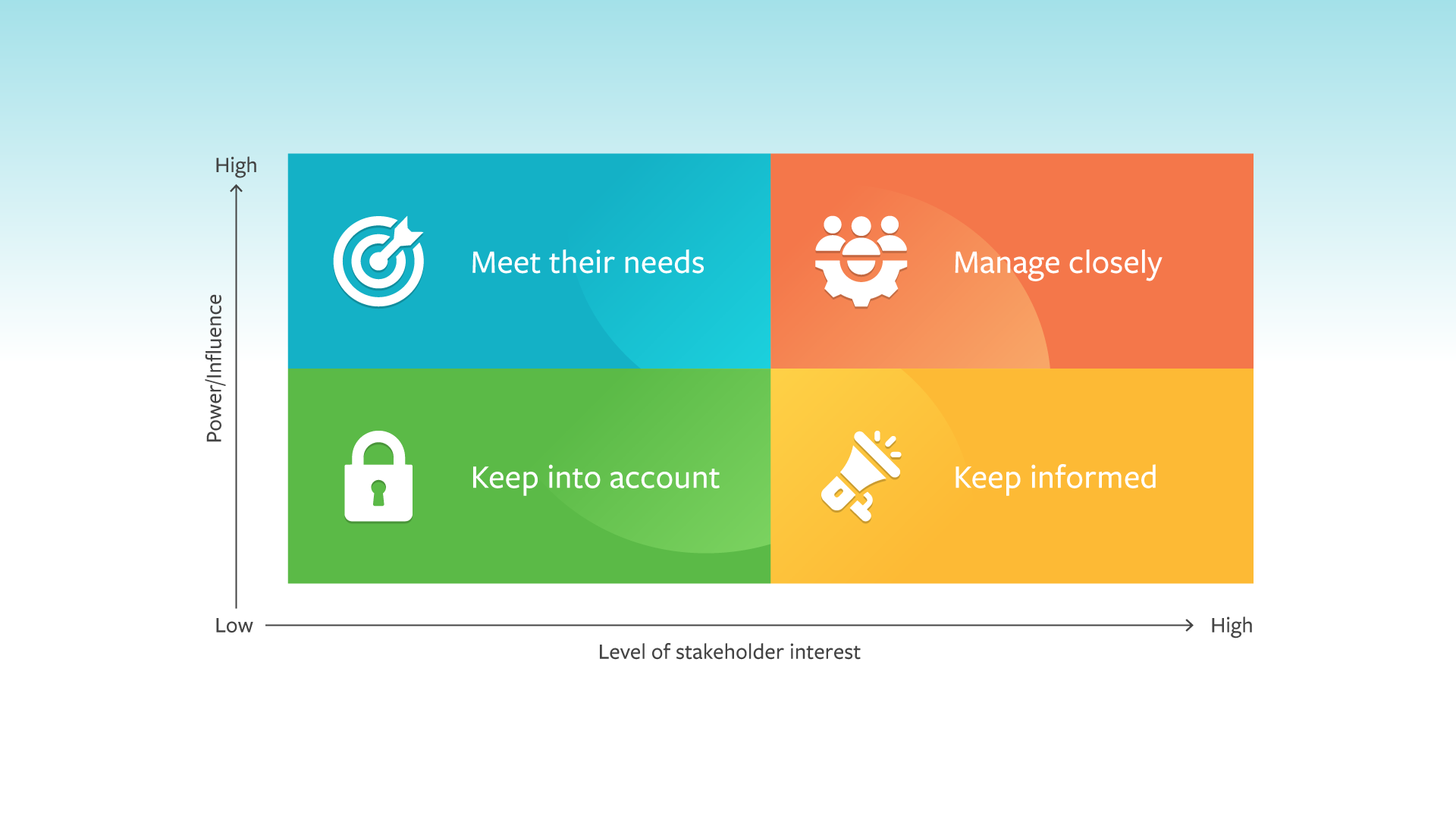
The standard power/interest grid divides stakeholders into four quadrants:
1. High power, high interest
Manage closely. These are your most critical stakeholders. They need frequent, detailed updates and direct access to your team. Think executive sponsors, senior government officials, or Indigenous rights holders in consultation processes.
2. High power, low interest
Keep satisfied. These stakeholders can significantly impact your project, but aren't closely watching it day to day. Regulatory bodies or senior executives with peripheral roles often fall into this category. Periodic, well-structured updates keep them confident without overwhelming them.
3. Low power, high interest
Keep informed. This is the classic "keep informed stakeholders" quadrant. These are engaged stakeholders who care about your project but have limited decision-making authority.
Community groups, residents near a project site, or advocacy organizations often sit here. They need reliable access to information through public-facing channels like newsletters, websites, and open community meetings.
4. Low power, low interest
Monitor. Minimal communication is appropriate here. General public awareness, press releases, or social media posts are usually sufficient.
Remember, a stakeholder's position in the matrix isn't fixed. As a project evolves, interest and influence can shift. Someone who starts as a low-power observer can become a high-influence advocate or opponent. Your communication strategy should account for that movement.
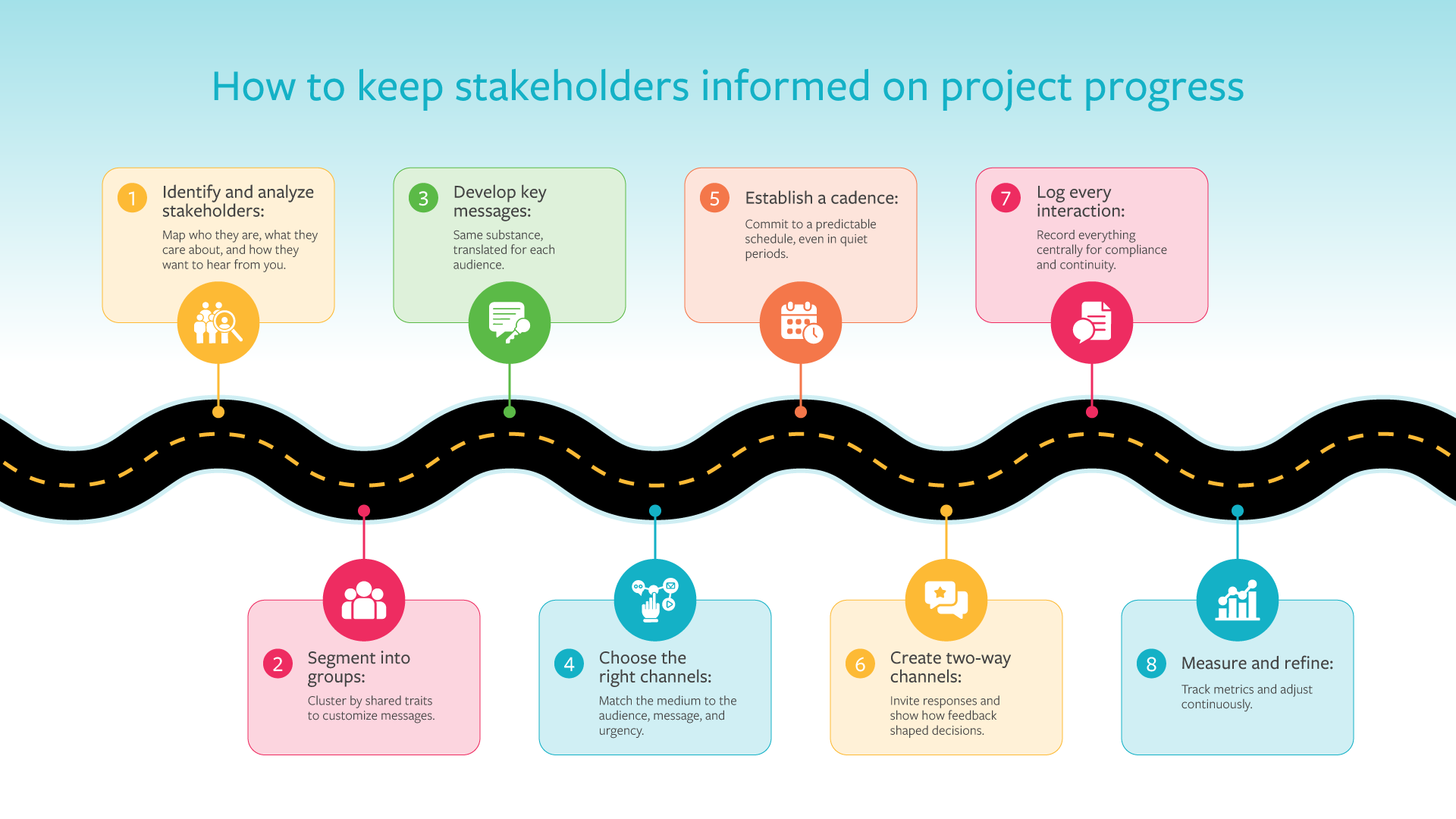
How to keep stakeholders informed on project progress
Step 1: Identify and analyze your stakeholders
You can't tailor communication without knowing whom you're communicating with. A stakeholder analysis helps you map your stakeholders, what they care about, and the level of engagement they expect. This is the non-negotiable first step.
For each group, document their key concerns, their preferred communication channels, how often they want to hear from you, and any sensitivities relevant to your project.
Step 2: Segment your stakeholders into groups
Once you've mapped your stakeholders, group them by shared characteristics, geography, interest level, organizational type, or project impact. This makes it practical to create targeted messages rather than a single communication that lands poorly for everyone.
A renewable energy company, for example, might segment into provincial and federal regulators, Indigenous communities, local landowners, environmental NGOs, and the general public. Each group gets different content, different cadence, and different channels.
Step 3: Develop key messages
Key messages are the core set of statements you want different stakeholder groups to understand and believe. They should be consistent in substance across all channels while being adapted to the language and details of each audience.
A technical update appropriate for a regulatory submission is very different from the language that belongs in a community newsletter. Both can carry the same truth. They just need to be translated for their audience.
Step 4: Choose the right channels
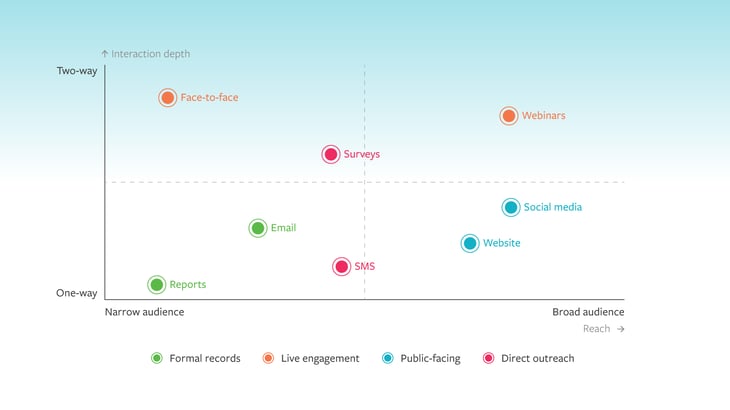
Channel selection is one of the most consequential decisions in any communication strategy. The right channel depends on the audience, the nature of the message, urgency, and the level of interaction you need. We'll cover specific channels in the section below.
Step 5: Establish a regular communication cadence
Consistency builds credibility. When stakeholders know when to expect updates, they're less likely to fill information gaps with speculation or rumour. Map out a communication schedule for each channel and stakeholder group, and treat that schedule as a commitment, even during quieter periods when there's little to report.
Step 6: Create two-way channels
Communication that only flows one way isn't engagement. Create structured opportunities for stakeholders to respond, such as surveys, open comment periods, Q&A sessions at public meetings, or a dedicated email inbox. More importantly, close the loop. When stakeholders see their feedback reflected in a decision or a project update, they're more likely to stay engaged and trust the process.
Step 7: Log every interaction
Every email sent, every meeting held, and every piece of feedback received should be recorded in a centralized stakeholder management software. This record protects you from compliance risk, provides your team with the context they need to personalize future communications, and ensures institutional knowledge doesn't walk out the door when staff change.
Step 8: Measure and refine
Track engagement metrics: email open rates, survey response rates, attendance at public events, and sentiment trends over time. Use those insights to adjust your approach. The most effective teams treat stakeholder communication as something to continuously improve, not a one-time task.
Best channels for keeping stakeholders informed
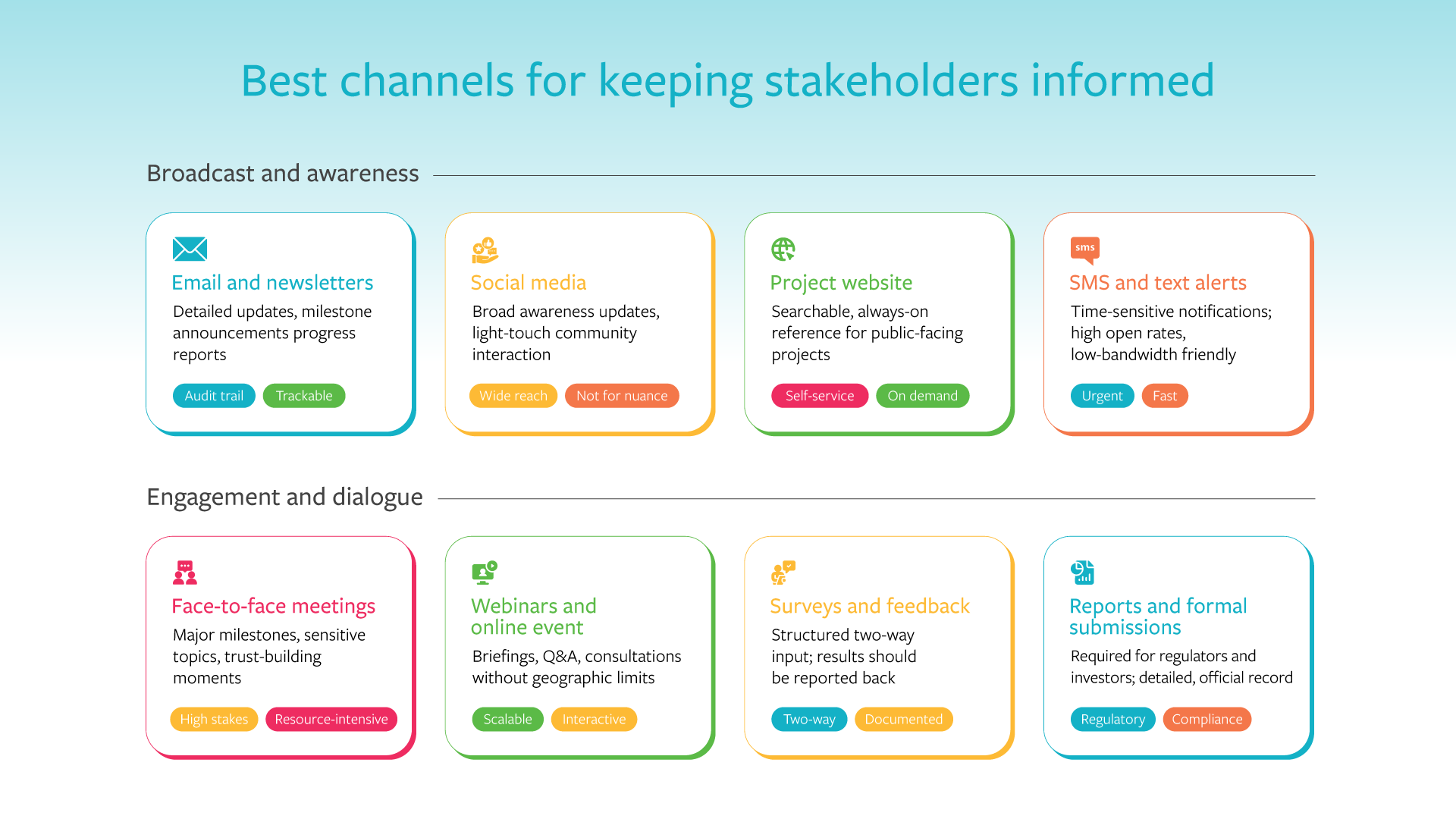
No single channel works for all stakeholders. Effective organizations use a deliberate mix and align each channel to the specific audience, purpose, and timing most appropriate for that group.
-
Email and newsletters work well for detailed project updates, milestone announcements, and regular progress reporting. They're trackable and create an audit trail, which matters for compliance-heavy projects.
-
Face-to-face meetings and community events are best for major milestones, sensitive conversations, or situations where trust needs to be actively built. They're resource-intensive but irreplaceable for high-stakes engagement.
-
A project website or dedicated web page gives stakeholders a reliable, searchable place to find information on their own schedule. For public-facing projects, this is often the first place stakeholders look.
-
Social media works for broad awareness updates and lighter-touch community interaction. It's not appropriate for nuanced, sensitive dialogue, but it keeps your project visible and accessible to a wider audience.
-
SMS and text alerts are the fastest channel for time-sensitive notifications. They have exceptionally high open rates and are particularly useful for communities with variable internet access.
-
Reports and formal submissions are required for regulatory stakeholders and investor audiences. They're formal, detailed, and create a documented record of your organization's position and actions.
-
Surveys and feedback forms support two-way communication and give stakeholders a structured way to share input. Importantly, the results should be documented and reported back to participants.
-
Webinars and online events allow broad participation without geographic constraints. They work well for stakeholder briefings, Q&A sessions, and consultation activities when face-to-face isn't feasible.
Choose channels based on what your stakeholders use and prefer, not what's most convenient for your team.

Keep stakeholders informed during a crisis
Crisis communication is where the stakes of keeping stakeholders informed are highest, and where poor communication causes the most lasting damage.
The organizations that manage crises well communicate early and honestly, even when the full picture isn't yet clear. They say what they know, acknowledge what they don't know, and commit to following up when they have more information. And they don't wait for stakeholders to ask.
For stakeholders, uncertainty is often harder to manage than bad news. When information is absent, speculation fills the gap, and rumours tend to be worse than reality.
Here's how to keep stakeholders informed during a crisis:
-
Communicate immediately: As soon as a crisis is identified, reach out to key stakeholders, even if your message is only "we're aware of the situation and are working to understand it fully."
-
Segment your stakeholders and tailor your messages: Each stakeholder group has distinct concerns. Investors care about financial stability. Communities care about local impact. A single generic message won't serve any of them well.
-
Use the right channel for the urgency: SMS for immediate alerts. Email for detailed updates with documentation. You can use direct calls for your highest-priority stakeholders. Social media for broad public-facing updates.
-
Maintain consistency: All stakeholder groups should receive the same core facts. Inconsistent messaging across audiences destroys credibility fast.
-
Don't disappear after the first update: Crisis communication is a sustained process. Even when there's little new to share, a brief "here's where things stand, we'll update you again by (date)" keeps trust intact and prevents speculation from taking hold.
-
After the crisis, report back: Stakeholders affected by a crisis want to know what happened, why, and what's being done to prevent it from happening again. A transparent post-crisis communication demonstrates accountability and helps rebuild trust.
Common mistakes that break stakeholder trust
Even teams with good intentions make these errors. Recognizing them is the first step to avoiding them.
-
Communicating only in one direction: Sending updates without a mechanism for response isn't stakeholder communication; it's broadcasting. Stakeholders who have no avenue to share feedback or ask questions feel sidelined and uninformed.
-
Using a one-size-fits-all message: A single communication sent to everyone regardless of their interests, knowledge level, or relationship to the project will resonate with almost no one. Segmentation is non-negotiable.
-
Going quiet during uncertainty: The instinct to wait until you have something definitive to report is understandable, but it backfires. Regular updates, even brief ones, prevent rumours and demonstrate that you're in control.
-
Failing to close the feedback loop: Asking stakeholders for input and then never showing them where that input went tells them their participation didn't matter. Every consultation process should include a "you said, we did" communication that shows how feedback shaped decisions.
-
Not documenting interactions: Without a centralized record of whom you've talked to, what was discussed, and what was promised, your team is operating without institutional memory. When staff leave or a regulator requests documentation, the absence of records becomes a serious problem.
-
Choosing channels based on organizational preference: Communicating through the channels your team finds easiest to use, rather than the ones your stakeholders actually use, is one of the most common and costly mistakes in stakeholder communication.

How Jambo helps teams keep stakeholders informed
Jambo is Stakeholder Relationship Management (SRM) software built specifically for the kinds of teams described throughout this guide: government departments, infrastructure and transportation teams, natural resource and energy companies, and any organization running complex, compliance-sensitive engagement programs.
Here's how Jambo makes it practical to keep stakeholders informed at scale:
-
Centralized stakeholder database: Every contact, every organization, every interaction is stored in one place. No more searching across inboxes, spreadsheets, and shared drives to piece together a stakeholder's history with your project.
-
Interaction logging: Log calls, meetings, emails, and site visits directly in Jambo, with full context attached. Your team always knows what's been communicated, who said what, and when follow-up is due.
-
Stakeholder metadata and tagging: Apply metadata to your stakeholder records in flexible ways, such as by geography, interest area, engagement level, project phase, or custom tags, so you can more easily find, select, and report on the right groups. Use these attributes to target communications to the people they're most relevant to, without locking stakeholders into rigid categories.
-
Issues and sentiment tracking: Track stakeholder concerns and sentiments over time. Spot patterns, identify emerging issues before they escalate, and demonstrate to regulators and leadership that you're actively managing your engagement program.
-
Audit-ready reporting: Generate reports in seconds for regulatory submissions, leadership briefings, or internal reviews. When a regulator requests documentation of your consultation activities, Jambo provides the necessary records to support them.
-
Built for compliance: Jambo is used by federal and provincial government teams across Canada, UK government teams, and organizations where documentation of stakeholder communication is legally significant.
If your team is managing stakeholder communication across spreadsheets, shared inboxes, or a generic CRM that wasn't built for stakeholder engagement work, book a demo with Jambo to see how purpose-built SRM software changes the way your team works.

Frequently Asked Questions (FAQs) about keeping stakeholders informed
1. What does it mean to keep stakeholders informed?
Keeping stakeholders informed means making sure the right people receive accurate, timely, and relevant information about decisions, progress, and changes that affect them. It includes not just outbound updates but also listening to feedback and demonstrating that input has been considered.
2. How often do you think you should communicate with stakeholders?
It depends on the stakeholder group and project phase. Key internal stakeholders and project sponsors typically need weekly or milestone-driven updates. Community stakeholders benefit from regular newsletters and event-based engagement. Regulatory bodies usually require formal quarterly or milestone reporting. The most important thing is consistency, regardless of the cadence you choose.
3. How do you keep stakeholders informed during a crisis?
Communicate early, even when you don't have the full picture. Tailor your messages to each stakeholder group's specific concerns. Use the right channels for the urgency (SMS for immediate alerts, email for detailed updates). Maintain consistent messaging across all groups. Continue communicating throughout the crisis, not just at the start. Follow up post-crisis to show accountability.
4. Why is it important to keep stakeholders informed?
Consistent, proactive stakeholder communication builds trust, reduces project risk, improves decision quality, satisfies regulatory requirements, and helps organizations maintain their social license to operate. Failing to keep stakeholders informed is one of the most common causes of project delays, community opposition, and reputational damage.