Structured teams communicate regularly with stakeholders, but the most effective teams communicate proactively. They treat every interaction as an opportunity to build trust, gather insights, and reduce risk. Whether you are overseeing a major infrastructure project, rethinking a local bus route, or leading a community relations initiative, mastering stakeholder communication is a non-negotiable skill. This comprehensive guide covers everything you need to know about stakeholder communication: what it is, why it matters, how to do it well, and how to build a plan that actually drives results. Use the table of contents below to jump to the section most relevant to you.
TL;DR - Key takeawaysShort on time? Here is everything you need to know about stakeholder communication in under two minutes.
|
Table of Contents
- What is stakeholder communication?
- Why is stakeholder communication important?
- The consequences of poor stakeholder communication
- Types of stakeholders you need to communicate with
- Key methods and channels of stakeholder communication
- Best practices for effective stakeholder communication
- How to create a stakeholder communication plan (step-by-step)
- What is a stakeholder communication matrix?
- How to measure and improve your communication strategy
- Tools to manage stakeholder communication
- Frequently Asked Questions: stakeholder communication
What is stakeholder communication?
Stakeholder communication refers to all verbal and written exchanges between an organization and the individuals or groups affected by, interested in, or influencing its activities. It encompasses both outbound messaging (what an organization shares with stakeholders) and inbound feedback (what stakeholders share with an organization).
In project management, stakeholder communication is the structured process of keeping all relevant parties informed, engaged, and aligned throughout a project lifecycle. In broader organizational contexts, it forms the backbone of stakeholder relationship management, ensuring that every group with a legitimate interest in your work receives the right information at the right time through the right channel.
Key definition: Stakeholder communication is a two-way process that involves listening, responding, and adapting to stakeholder input.
Why is stakeholder communication important?
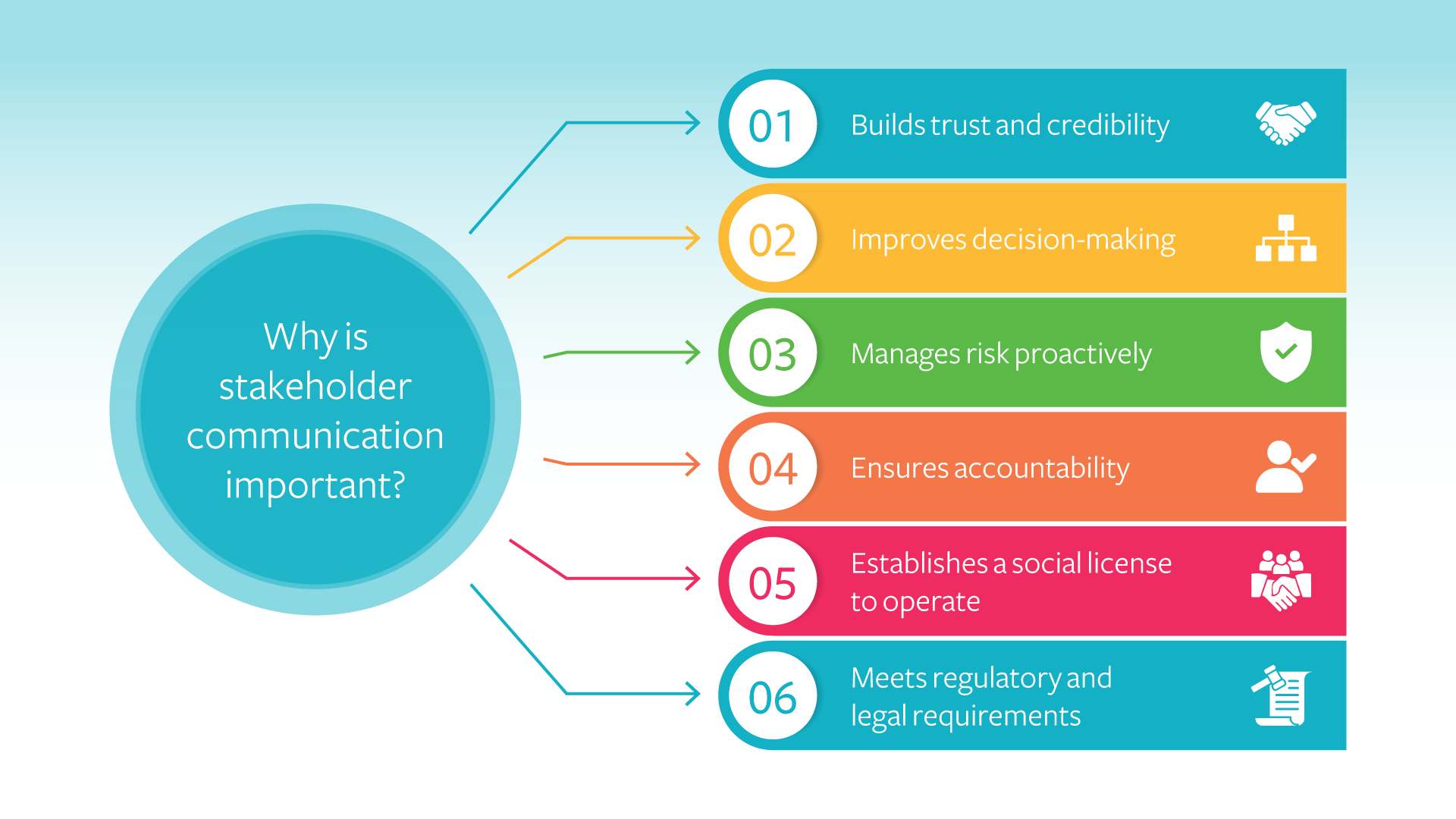
Effective stakeholder communication delivers measurable operational and strategic value. Here are reasons why organizations that invest in it consistently outperform those that do not.
-
Builds trust and credibility
Regular, transparent communication signals that your organization has nothing to hide. Stakeholders who receive consistent, honest updates are far more likely to trust your intentions, support your decisions, and advocate for your project in their own networks. Trust is the currency of strong stakeholder relationships, and communication is how you earn it.
-
Improves decision-making
When you actively engage a diverse range of stakeholders, you gain access to perspectives, local knowledge, and potential roadblocks that your team would never discover in isolation. Consider a municipality planning a new road: consulting only residents might miss the needs of commuters, school communities, and business travellers, each of whom might identify critical design requirements like parking, transit links, or wider lanes. Simply put, the more stakeholder input you gather, the better your decisions will be.
-
Manages risk proactively
Poor or absent stakeholder communication is one of the most common root causes of project delays, cost overruns, and reputational damage. Proactive communication allows you to identify concerns early, address misconceptions before they become complaints, and head off opposition before it escalates into protest or legal action.
-
Ensures accountability
Transparent communication creates accountability in both directions. When stakeholders can see what your organization is doing and why, they hold you to your commitments. And when you regularly brief external partners, contractors, and community groups, you can also hold them accountable for their own milestones and deliverables.
-
Establishes a social license to operate
Particularly in infrastructure, resource extraction, and large-scale development projects, organizations need more than regulatory approval; they need social acceptance. Ongoing, respectful dialogue with host communities, indigenous groups, and environmental stakeholders is how organizations earn and maintain that social license to operate.
-
Meets regulatory and legal requirements
In many industries and jurisdictions, stakeholder consultation is not optional. Environmental impact assessments, planning applications, and international standards such as Free, Prior, and Informed Consent (FPIC) all carry explicit communication requirements. A robust stakeholder communication program protects you from compliance failures and demonstrates good faith to regulators.
The consequences of poor stakeholder communication
The risks of neglecting stakeholder communication are significant and well-documented. Organizations that fail to communicate effectively with their stakeholders can face:
| Risk area | Potential consequences |
| Regulatory non-compliance | Delays, fines, permit revocations, or forced shutdowns due to failure to meet consultation requirements |
| Loss of investor confidence | Withdrawal of funding and reputational damage when investors are not kept informed of risks |
| Community opposition | Public protests, legal challenges, and work stoppages driven by local resistance |
| Project delays and cost overruns | Misaligned expectations lead to rework, scope changes, and budget blowouts |
| Reputational damage | Negative media coverage and lasting harm to brand perception |
| Missed opportunities | Failure to capture valuable insights that could have improved outcomes |
In the most severe cases, a breakdown in communication between an organization and its stakeholders can lead to operational disasters with long-lasting human, environmental, and financial consequences.
Types of stakeholders you need to communicate with
Before you can communicate effectively, you need to know who your stakeholders are. Stakeholders are typically divided into two broad categories:
Internal stakeholders
- Executive leadership and board members
- Project sponsors and investors
- Employees and managers
- Contractors and consultants
External stakeholders
- Government bodies and regulators
- Local and Indigenous communities
- Environmental and advocacy groups
- Suppliers, vendors, and business partners
- Customers and end-users
- Media and public interest organizations
- Donors and funding bodies
Key methods and channels of stakeholder communication
One of the most consequential decisions in stakeholder communication is channel selection. The right channel depends on your audience, the nature of the message, the urgency of the update, and the level of engagement you need.
Common stakeholder communication channels
| Channel | Best for | Typical frequency |
| Detailed project updates, newsletters, and formal notifications | Weekly, fortnightly, or monthly | |
| SMS/text | Time-sensitive alerts, event reminders, urgent notifications | As needed |
| Phone calls | Sensitive conversations, relationship-building, Q&A | As needed |
| Face-to-face meetings | Major milestone consultations, community engagement events | At key project phases |
| Social media | Broad awareness, informal updates, community interaction | Daily to several times per week |
| Letters | Formal notifications, compliance documentation, and a wide reach | Monthly or quarterly |
| Reports | Regulatory submissions, investor briefings, public disclosures | Quarterly or annually |
| Surveys/forms | Gathering structured feedback from stakeholder groups | Per the engagement phase |
| Direct messaging (Slack, Teams) | Internal team coordination and real-time project updates | Daily or as needed |
| Webinars / online events | Remote consultations, broad stakeholder briefings | At milestones |
No single channel works for all stakeholders. Effective organizations use a mix of channels and align each channel to the specific audience, purpose, and cadence most appropriate for that group.
Best practices for effective stakeholder communication
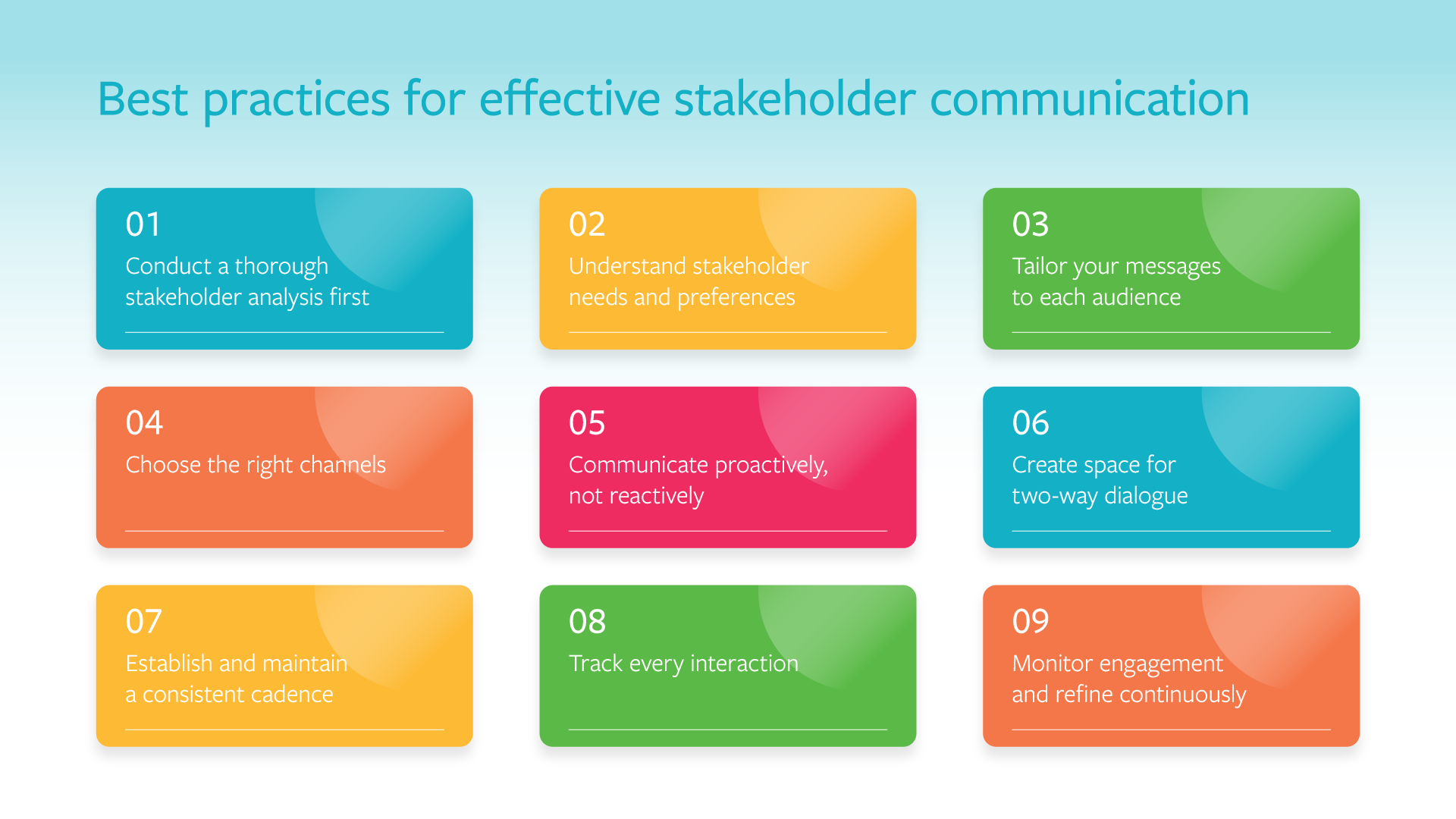
Understanding the theory of stakeholder communication is one thing; executing it consistently is another. The following best practices separate good communicators from great ones.
-
Conduct a thorough stakeholder analysis first
You cannot tailor communication without knowing your audience. A stakeholder analysis helps you identify your stakeholders, what they care about, how much influence they have, and the appropriate level of engagement. Use this analysis to inform every aspect of your communication strategy, from channel selection to message framing.
-
Understand stakeholder needs and preferences
Put yourself in your stakeholders' shoes. What information do they need? How often do they want to hear from you? What format do they prefer? What concerns are they most likely to raise? The more clearly you can answer these questions, the more relevant and effective your communications will be.
-
Tailor your messages to each audience
A single message rarely works for all stakeholders. The level of technical detail appropriate for a regulatory submission is very different from the language you would use in a community newsletter. Segment your stakeholders into groups and create targeted messages that speak directly to each group's interests, concerns, and vocabulary.
-
Choose the right channels
Identify not just where your stakeholders are, but what they expect from each channel. A social media post is appropriate for a broad update but inappropriate for a sensitive one-on-one dialogue. An email newsletter is effective for regular project updates, but too slow for urgent notifications. Match the medium to the message and to the audience.
-
Communicate proactively, not reactively
The most effective organizations don't wait for stakeholders to raise concerns; they share information before questions arise. Proactive communication reduces uncertainty, builds confidence, and prevents rumours from filling the information vacuum. Establish a regular update cadence and stick to it, even when there is nothing dramatic to report.
-
Create space for two-way dialogue
Stakeholder communication is not a broadcast function. Effective engagement requires listening as much as speaking. Provide multiple ways for stakeholders to respond, such as surveys, open comment periods, Q&A sessions, dedicated email inboxes, and face-to-face meetings. And critically: demonstrate that you have heard and acted on their input. When stakeholders see their feedback reflected in decisions, they are far more likely to remain engaged.
-
Establish and maintain a consistent cadence
Consistency builds credibility. When stakeholders know when to expect updates, they trust that you will keep them informed. Irregular or infrequent communication, particularly during periods of uncertainty, creates anxiety and fuels speculation. Map out a communication schedule for each channel and stakeholder group and treat it as a commitment.
-
Track every interaction
Every email sent, every meeting held, and every piece of feedback received should be logged in a centralized stakeholder management system. This record is essential for compliance and reporting purposes, but it also gives your team the context they need to personalize future interactions, avoid repeating questions, and demonstrate responsiveness. Without a reliable record, institutional knowledge disappears when team members change.
-
Monitor engagement and refine continuously
Measure the effectiveness of your communications regularly. Track email open rates, social media engagement, survey response rates, and changes in stakeholder sentiment over time. Use these insights to refine your approach, doubling down on what works and adjusting what does not. Apply your learnings to every future engagement.

How to create a stakeholder communication plan (step-by-step)
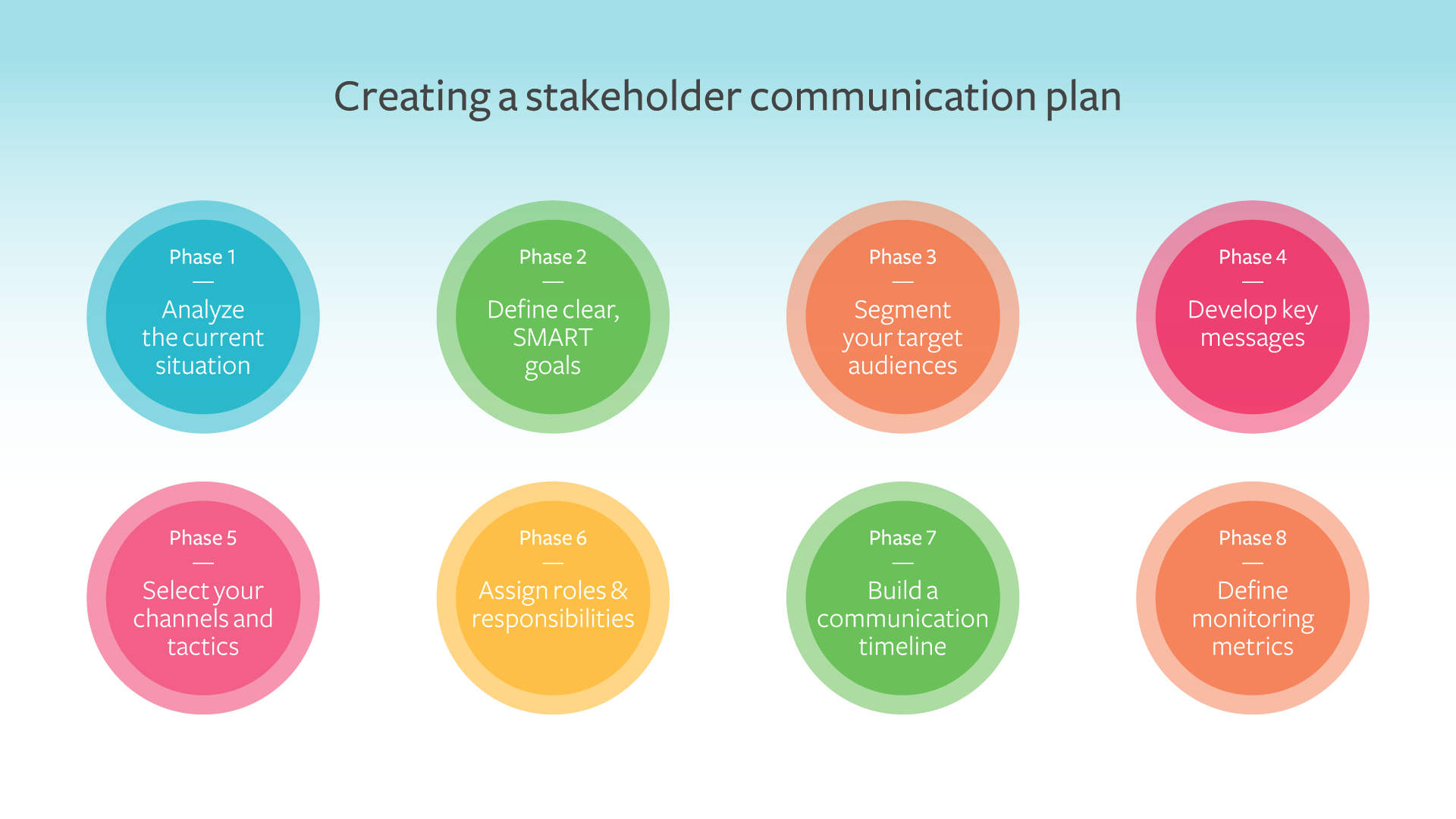
A stakeholder communication plan is a strategic document that defines how your organization will communicate with stakeholders throughout a project or initiative. It covers objectives, target audiences, key messages, channels, responsibilities, timelines, and evaluation criteria. Here are the steps to create one:
-
Analyze the current situation
Begin by auditing your existing communications and channels. Review what is currently working, what your stakeholders know and believe, and the gaps. Consider a SWOT analysis, benchmarking against peers, and a review of any relevant brand or communication guidelines.
-
Define clear, SMART goals
Set specific, measurable objectives for your communication program. Examples include:- Ensure 90% of identified stakeholders are aware of the project by the end of Q2
- Increase positive sentiment among community stakeholders from 45% to 65% over six months
- Achieve a 30% survey response rate from the regulatory stakeholder group
-
Define and segment your target audiences
List the stakeholder groups you plan to reach. For each group, describe their key characteristics, interests, concerns, and preferred communication styles. Creating simple stakeholder personas can be a helpful way to humanize each group and keep your messaging grounded in their reality.
-
Develop key messages
Key messages are a set of 5-10 short, clear statements that summarize what you want your stakeholders to know and believe about your project. They should be consistent across all channels while being adapted in tone and detail for each audience. Good key messages are honest, relevant, and repeatable.
-
Select your channels and tactics
Based on your audience analysis, select the communication channels most likely to reach each stakeholder group effectively. For each channel, define how you will use it: the type of content, the tone, and the specific tactics you will deploy.
-
Assign roles and responsibilities
Identify who is responsible for each element of your communications program. This typically includes:
- Overall communication lead or project communications manager
- Company spokesperson or executive representative
- Media and public relations contacts
- Online community manager (social media, comments, forums)
- Event coordinator (for face-to-face engagement activities)
- Crisis communication lead
-
Build a communication timeline
Map your planned communications against your project milestones. Identify when key messages need to go out, when consultation periods open and close, and when reports or updates are due. Establish a regular cadence for each channel (e.g., monthly email newsletter, weekly social media posts, quarterly community meetings).
-
Define monitoring and evaluation metrics
From the outset, define how you will measure success. Link your KPIs back to the goals you set in Step 2. Schedule regular reviews to assess performance, gather stakeholder feedback, and update the plan as circumstances change.
Learn more about the proven framework and tools to manage stakeholder relationships →
What is a stakeholder communication matrix?
.png?width=1920&height=1080&name=Building-Stakeholder-Communication-Matrix%20(1).png)
A stakeholder communication matrix is a visual tool that organizes all the key details of your communication strategy in one place. It shows who you are communicating with, what you are communicating, which channels you are using, how often you are reaching out, and who is responsible. Think of it as the operational backbone of your communication plan, a reference document that any team member can consult to understand their responsibilities and stay aligned with the broader strategy.
What a stakeholder communication matrix typically includes:
- Stakeholder name or group
- Role or relationship to the project
- Communication purpose (inform, consult, involve, collaborate, empower)
- Key messages or content to be shared
- Preferred communication channel(s)
- Frequency of communication
- Person responsible for the communication
- Notes on preferences, sensitivities, or history
How to build your stakeholder communication matrix in 8 steps
- Clarify the purpose of the matrix and how it aligns with your project goals
- Identify all stakeholders and their roles through a stakeholder analysis
- Define communication requirements and the level of detail appropriate for each group
- Select appropriate communication channels for each stakeholder group
- Establish a cadence for each group, based on their needs and the project phase
- Populate the matrix with all relevant details, structured in rows (stakeholders) and columns (attributes)
- Review and update the matrix regularly as the project evolves
- Use digital tools to make the matrix easy to access, update, and share
How to measure and improve your communication strategy
Stakeholder communication is not a set-and-forget activity. The best programs are built on a cycle of continuous improvement: communicate, measure, learn, and adapt.
-
Key metrics to track
- Email open rates and click-through rates
- Survey response rates and completion rates
- Social media engagement (reach, likes, comments, shares)
- Website traffic from stakeholder-specific content
- Attendance and participation rates at events and meetings
- Volume and sentiment of inbound stakeholder feedback
- Stakeholder satisfaction scores (if using a formal survey instrument)
- Changes in stakeholder sentiment over time
-
Conduct regular communication audits
Schedule quarterly or biannual reviews of your communication performance. Compare results against your original goals. Ask: Are we reaching the right people? Are they engaging? Are we hearing back from them? Has sentiment improved? What feedback themes are emerging?
-
Use sentiment analysis
Manually analyzing qualitative stakeholder feedback, email responses, community comments, and survey open text is time-consuming and prone to bias. Sentiment analysis tools can automatically categorize feedback by topic and emotional tone, giving you a more objective and scalable view of how your stakeholders feel and what they care about.
-
Report transparently
Share the results of your communication program with your leadership team, communications colleagues, and, where appropriate, with stakeholders themselves. Demonstrating that you listened, reported back, and acted on feedback is one of the most powerful ways to strengthen stakeholder trust and encourage ongoing engagement.
Discover innovative stakeholder management strategies to improve stakeholder relationships →
Tools to manage stakeholder communication
Managing stakeholder communication manually across spreadsheets, email inboxes, and shared drives quickly becomes unmanageable as projects grow in complexity. Dedicated stakeholder relationship management platforms can centralize your data, streamline your workflows, and give you the analytics you need to improve.
What to look for in a stakeholder communication tool:
- Centralized stakeholder contact database with full interaction history
- Stakeholder communication tracking
- Stakeholder mapping and segmentation tools
- Sentiment analysis
- Stakeholder issue and commitment management
- Reporting and audit trails
- Team collaboration features and role-based access
- Integration with existing communication channels (email clients, CRMs)
Platforms such as Jambo offer all of these features in a purpose-built environment, allowing teams to move away from disconnected spreadsheets and toward a more strategic, data-driven approach to stakeholder communication management.
Frequently Asked Questions (FAQs) about stakeholder communication
What is the difference between stakeholder communication and stakeholder engagement?
Stakeholder communication is one component of stakeholder engagement. Engagement is the broader process of building and managing relationships with stakeholders, encompassing consultation, collaboration, and co-design activities, not just information sharing. Communication specifically refers to the transfer of information between parties.
How often should you communicate with stakeholders?
There is no single right answer; it depends on the project phase, the stakeholder group, and the urgency of the information. As a general guide: key internal stakeholders (leadership, project sponsors) typically need weekly or milestone-driven updates; community stakeholders benefit from monthly newsletters and event-based engagement; regulatory bodies typically require formal quarterly or milestone reporting.
What should a stakeholder communication plan include?
A comprehensive stakeholder communication plan should include: goals and objectives; stakeholder audience descriptions; key messages; selected communication channels; roles and responsibilities; a communication timeline; and a monitoring and evaluation framework.
What is a stakeholder communication matrix used for?
A stakeholder communication matrix is used to organize and visualize your communication strategy at a granular level. It ensures that every stakeholder group receives the right information through the right channel at the right time, and that someone on your team is clearly accountable for each communication.
What are the most common stakeholder communication mistakes?
-
Communicating only in one direction (broadcasting without listening)
-
Using a one-size-fits-all message across diverse stakeholder groups
-
Communicating too infrequently or only during crises
-
Failing to document or track stakeholder interactions
-
Neglecting to close the feedback loop by reporting back on what was heard and how decisions were made
-
Choosing channels based on organizational preference rather than stakeholder preference
Final thoughts
Stakeholder communication is a strategic asset that builds trust, reduces risk, improves decision-making, and creates the conditions for lasting organizational success. The organizations that communicate most effectively with their stakeholders share a few common traits: they invest in understanding their audiences before they start talking; they treat communication as a two-way process; they maintain consistency over time; and they constantly learn from the feedback they receive. Whether you are starting from scratch or looking to elevate an existing program, the frameworks, best practices, and tools covered in this guide give you everything you need to communicate with your stakeholders more strategically, more authentically, and more effectively.
Ready to improve your stakeholder communication?
Start by conducting a stakeholder analysis, mapping your audiences, and drafting your first stakeholder communication plan. Use a dedicated stakeholder relationship management software to centralize your records and measure your impact. The sooner you invest in a more strategic approach, the sooner you will see the results.