Everyone keeps talking about stakeholders - in boardrooms, on project calls, and in annual reports. But what does stakeholder mean? Who counts as one, and why does it matter so much? This guide answers everything, from the simple definition to the theory that changed how modern business thinks.
TL;DR: Key takeaways
Stakeholder meaning at a glance:
|
Table of Contents:
- What is the stakeholder meaning? A clear definition
- Where does the word "stakeholder" come from
- The types of stakeholders
- Common stakeholder groups
- Stakeholder examples across industries
- Stakeholder vs. shareholder: what's the difference?
- Stakeholder theory: why it matters
- What is stakeholder management?
- Stakeholder analysis: a step-by-step breakdown
- Why stakeholder thinking matters today
What is the stakeholder meaning? A clear definition
 Let's start right at the beginning. If you've been nodding along in meetings every time someone says "we need to consider our stakeholders" without being entirely sure what that means, you're not alone. The word gets thrown around a lot. Here's what it actually means.
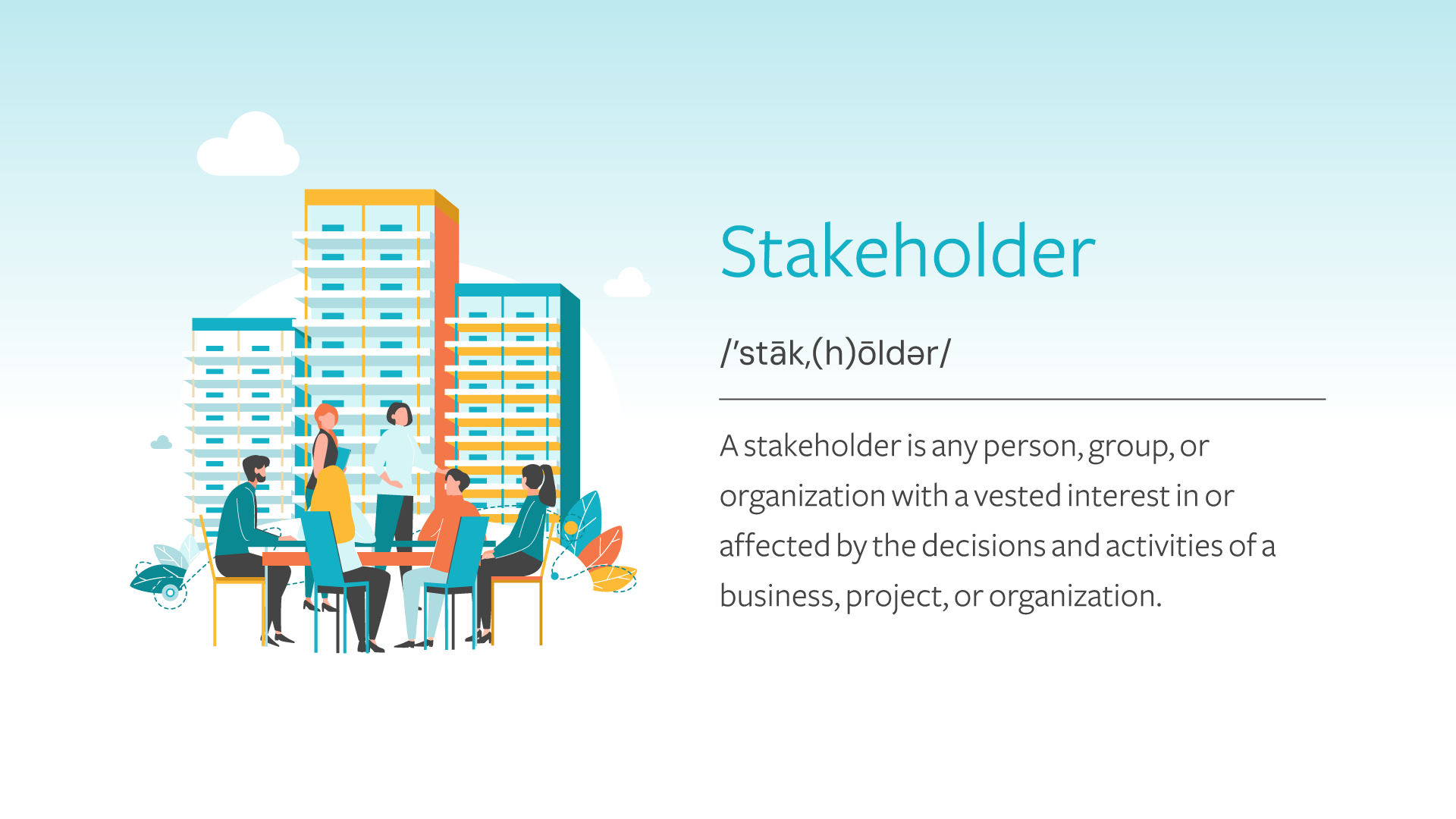
| A stakeholder is any person, group, or organization with a vested interest in, or affected by, the decisions and activities of a business, project, or organization. Stakeholders can be insiders (employees, managers, owners) or outsiders (customers, governments, communities). Their support or opposition can make or break a project's success. |
In plain English: If what a company does affects your job, your wallet, your safety, or your community, you're a stakeholder. You don't need a fancy title or a share certificate. You just need to have something at stake.
The International Organization for Standardization's ISO 26000, the globally recognized standard for corporate social responsibility, defines a stakeholder as "an individual or group that has an interest in any decision or activity of an organization." That's a deliberately wide net, and it's cast that way on purpose. The standard identifies three ways you can tell if someone is a stakeholder:
- The organization has a legal obligation to them
- They might be positively or negatively affected by the organization's decisions
- They are likely to express concerns about, or actively engage with, the organization's activities
Where does the word "stakeholder" come from
The word itself has a satisfyingly literal origin. It comes from the English verb "to stake," which means to wager or put something at risk, the same root you'd find in "staking a claim" or "raising the stakes." A stakeholder, literally, is someone who holds a stake in something.
Historically, a "stakeholder" in legal terms was also the neutral third party who held contested money or property while a court decided who truly owned it. Think of an escrow holder. That older legal meaning has since expanded dramatically into the business and management world.
In modern business use, it simply means anyone who has put time, money, reputation, or other value on the line and thus cares about outcomes.
Historical note: One of the earliest uses of the term in a modern business context is traced to an internal memo at the Stanford Research Institute in 1963, which described stakeholders as "those groups without whose support the organization would cease to exist."1 But it was R. Edward Freeman's 1984 book that cemented the concept in mainstream management thinking. More on that in the stakeholder theory section below.

The main types of stakeholders explained
Not all stakeholders are the same. Some are deep inside the organization; others orbit it from the outside. Some have direct financial exposure; others are affected in more subtle ways. You can group stakeholders in several useful ways:.png?width=730&height=411&name=Types-Of-Stakeholders_Design2%20(1).png)
Internal vs. external stakeholders
This is the most fundamental divide and the one you'll encounter most often.
-
Internal stakeholders
People who work within the organization and have a direct stake in its day-to-day operations and outcomes. Their livelihood is directly tied to the organization's health.
-
External stakeholders
People or groups outside the organization who are nonetheless affected by the organization's activities. They may not work there, but they feel the ripples of its decisions.
Primary vs. secondary stakeholders
Another common framework sorts stakeholders by how directly they feel an organization's impact.
-
Primary stakeholders
Those who are directly involved in economic transactions with the organization, such as investors, employees, customers, and suppliers. Their relationship is close and often contractual.
-
Secondary stakeholders
Indirectly affected parties include the media, activist groups, local communities, and NGOs. They have no direct economic exchange but can still wield enormous influence.
-
Potential stakeholders
Groups that aren't currently affected but could be in the future. Forward-thinking organizations identify these early to manage emerging risks and opportunities.
Learn more about understanding and strengthening stakeholder relationships →
Common stakeholder groups and what they care about
Let's walk through the most common types of stakeholders you'll encounter in any business or project context:
| Stakeholder type | Internal or external? | What they care about |
| Employees | Internal | Job security, fair pay, safe working conditions, and career growth |
| Managers and executives | Internal | Operational efficiency, KPIs, strategic direction, and bonus structures |
| Owners/board members | Internal | Profitability, organizational goals, governance, long-term value |
| Investors/shareholders | Internal/external | Financial returns, growth, dividend payments, voting rights |
| Customers | External | Product quality, fair pricing, good service, and reliability |
| Suppliers and vendors | External | Timely payments, ongoing contracts, and clear delivery terms |
| Creditors/banks | External | Debt repayment, interest payments, and financial stability |
| Government bodies and regulators | External | Tax compliance, legal adherence, employment, and GDP contribution |
| Local communities, land owners, business owners, etc | External | Environmental impact, jobs, safety, civic contribution |
| Media and NGO | External | Transparency, social responsibility, and ethical practices |
Stakeholder examples across industries
-
Example 1 - Construction and real estate
A construction company starting a new housing development has stakeholders that go far beyond the client paying for the build. Local residents care about noise, traffic, and environmental disruption.
Local government cares about zoning compliance and safety codes. Contractors and suppliers care about payment schedules and clear project specifications. The smart construction firm meets with neighbours before breaking ground, listens to their concerns, adjusts work hours, and builds goodwill that prevents costly delays down the line.
-
Example 2 - Healthcare
In healthcare, the stakeholder web is particularly complex. Patients want quality care at an affordable cost. Doctors and nurses want adequate staffing and resources. Hospital administrators need to balance budgets. Insurance companies want to minimize payouts. Pharmaceutical suppliers want orders fulfilled. Government regulators want compliance with health standards. When these groups pull in different directions, as they often do, patient outcomes suffer. Healthcare reform debates are, at their heart, disputes about whose stakeholder interests should take priority.
-
Example 3 - Legal context
In law, a "stakeholder" has a specific technical meaning: it refers to a neutral party holding money or property while a legal dispute over ownership is being resolved, similar to a modern escrow arrangement. This older legal meaning is where the business use of the term originally borrowed from, grounding the concept in the idea of holding something of value on behalf of others.

Stakeholder vs. shareholder: What's the difference?
This is one of the most commonly confused distinctions in business. The two words sound similar; they overlap significantly, and yet they are not the same thing. Getting this right is important.
| Dimension | Stakeholder | Shareholder |
| Definition | Anyone with an interest in, or affected by, an organization's actions | Someone who owns equity (shares/stock) in a company |
| Relationship to the company | Broad. It can be financial, social, legal, and environmental | Strictly financial, based on equity ownership |
| Includes | Employees, customers, suppliers, governments, communities, and shareholders | Only equity investors |
| Primary concern | Varies by group from jobs to service quality, community impact, and compliance | Share price, dividends, return on investment |
| Involvement | Can be involved in daily operations or affected indirectly | Usually not involved in day-to-day, mainly voting rights on major decisions |
| Who qualifies | A very wide group, almost anyone connected to the organization | Only those who have bought equity in the company |
The short version: all shareholders are stakeholders, but not all stakeholders are shareholders. A shareholder is a subset of the broader stakeholder universe, the one with direct financial ownership. A factory worker who has never owned a stock certificate is still absolutely a stakeholder. So is the community living downstream from that factory.
Stakeholder theory: why it matters
To understand why stakeholder meaning matters so much today, you have to understand where it came from and the one book that changed the world's perspective.
The year was 1984. Ronald Reagan was in the White House. The dominant business doctrine of the era, articulated by economist Milton Friedman in a famous 1970 New York Times essay, was that a company's only social responsibility was to increase its profits, as long as it did so within the law. Shareholders first. Everyone else is a distant second.
Into this environment stepped a young academic named R. Edward Freeman, a professor at the University of Virginia's Darden School of Business. Freeman published a slim but quietly revolutionary book: Strategic Management: A Stakeholder Approach. The initial print run was just 2,000 copies. Freeman hoped it might help him earn tenure. What he got instead was a fundamental shift in how business thinks about itself.
What stakeholder theory argues
Freeman's core argument was simple but radical for its time: a company is not just an engine for generating shareholder returns. It's a deeply human institution, embedded in a web of relationships with employees, customers, suppliers, communities, and many others. If you want to build a business that thrives over the long term, you have to manage all of those relationships, not just the one with your investors.
The core principle of stakeholder theory: Value is best created by maximizing joint outcomes, such as satisfying employees, customers, communities, and shareholders simultaneously. These goals are not in conflict; in fact, evidence suggests they're mutually reinforcing. Happy employees produce better products. Satisfied customers drive more revenue. Trusted communities create stable operating environments. That's a win for shareholders too.
Freeman drew a direct contrast with the shareholder model, which held that only the financial owners of a company truly mattered. He saw this as both morally narrow and practically self-defeating. "It's a business for human beings rather than a business for a few human beings," he later explained.
The three dimensions of stakeholder theory
Scholars Donaldson and Preston later identified three distinct but mutually reinforcing ways to understand stakeholder theory:
- Descriptive: Describes how organizations behave and how management thinks about various groups, how boards consider different constituencies.
- Instrumental: Identifies connections between stakeholder management and corporate performance, demonstrating that effective stakeholder management drives profitability and efficiency.
- Normative: Addresses how companies should behave, the moral and philosophical case for why managing for all stakeholders is the right thing to do.
What is stakeholder management, and how do you do it?
Knowing what a stakeholder is gets you halfway there. The other half is knowing how to manage them. Stakeholder management is the ongoing process of identifying, understanding, communicating with, and responding to the people and groups who have a stake in your project or organization.
Here's the truth about stakeholder management: it's part science, part diplomacy, and part just being a decent human being. The goal is to build positive, productive relationships with your stakeholders by understanding their needs, communicating proactively, and delivering on your commitments.
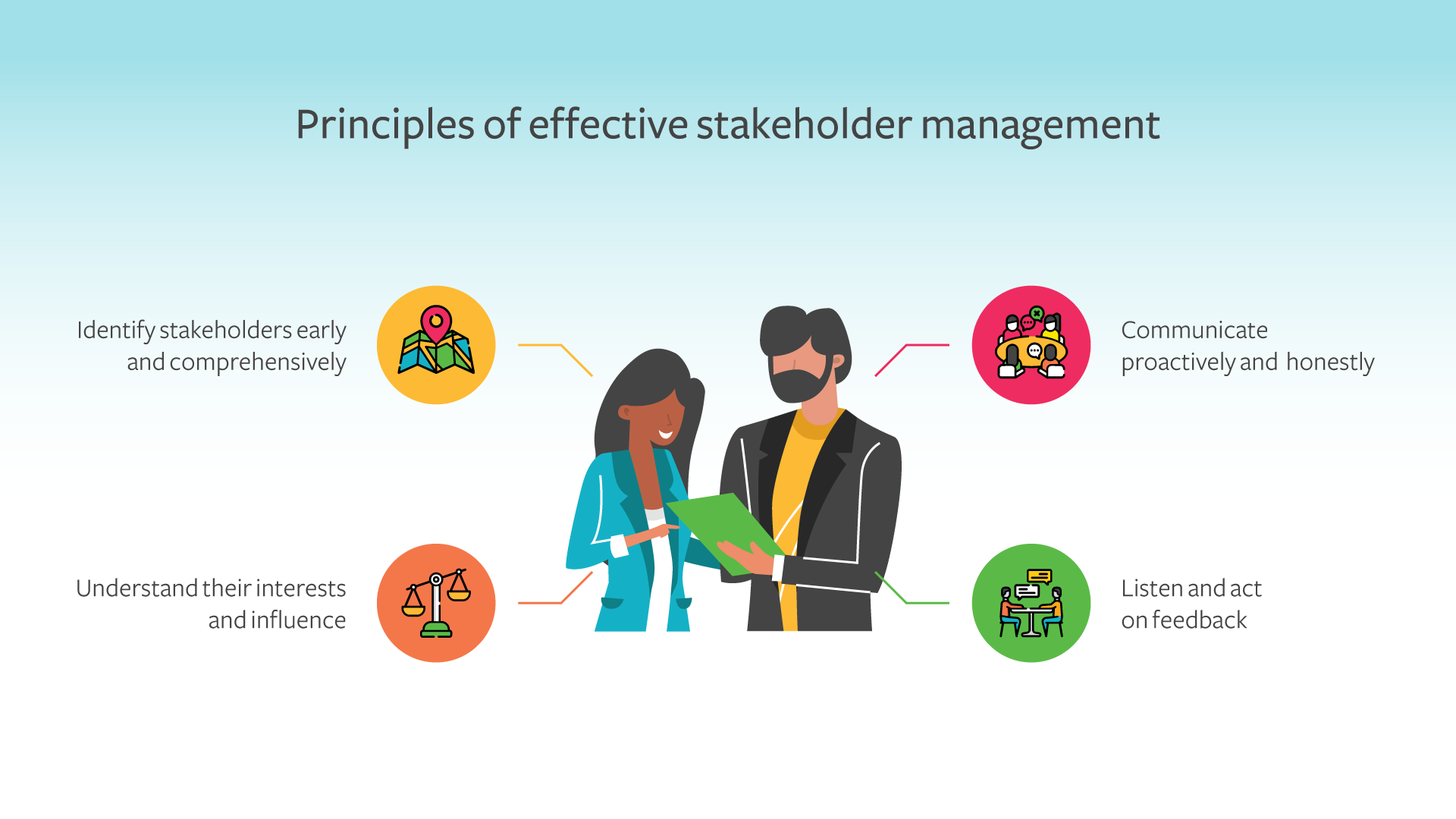
The four core principles of effective stakeholder management:
-
Identify stakeholders early and comprehensively
Don't wait until someone complains to find out they had a stake. Map out everyone who could be affected, even groups that seem peripheral. The neighbours who are fine with a quiet office building may not be fine with a construction site running at 6 am.
-
Understand their interests and influence
Not all stakeholders have equal power or equal concern. A major investor can pull funding overnight. A community activist group can take weeks to organize a protest. Know who has the most influence over your project's success, and tailor your engagement accordingly.
-
Communicate proactively and honestly
Avoid waiting for problems to surface before reaching out. Regular updates, even when there's nothing dramatic to report, build trust. Both good news and bad news should be shared. Stakeholders who feel blindsided become adversaries fast.
-
Listen and act on feedback
Stakeholder management isn't a broadcast channel. It's a two-way conversation. When stakeholders share concerns, stakeholders listen, and, where possible, act.
One practical tool many project managers use is a stakeholder map, a grid that plots stakeholders on two axes: level of interest and level of influence. Those with high interest and high influence need the most attention and engagement. Those with low interest and low influence can be monitored with lighter-touch communication.
Stakeholder analysis: a step-by-step breakdown
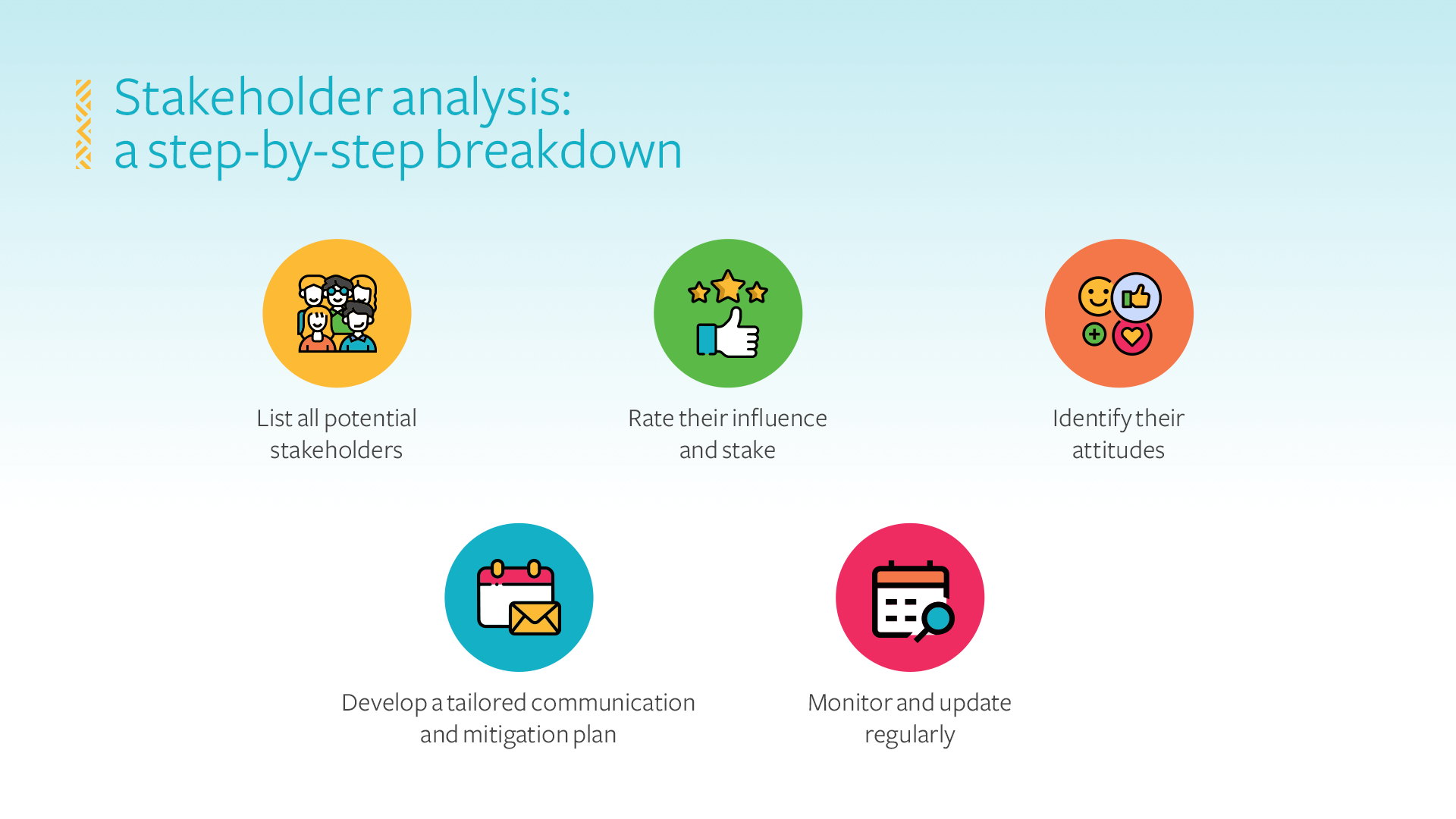
Stakeholder analysis is the structured process of identifying your stakeholders, assessing their positions, and developing a plan to engage them effectively. It's one of the most reliable tools for ensuring project success, and one of the most skipped, to everyone's cost.
-
List all potential stakeholders: Cast a wide net. Include obvious groups (employees, investors, customers) but also less obvious ones (local government, trade media, future users, community members). Ask: Who contributes to this project? Who receives value from it? Who could be harmed or disrupted by it?
-
Rate their influence and stake: Assign each stakeholder a rough rating for two dimensions: how much influence they have over your project's outcome, and how much they stand to gain or lose from it. This doesn't need to be a precise mathematical exercise; a simple high/medium/low scale works fine.
-
Identify their attitudes: Is each stakeholder a supporter (green), neutral (yellow), or a potential blocker (red)? Supporters can become advocates. Blockers need either reassurance or a concrete plan to address their concerns. Neutral parties can be swayed with the right communication.
-
Develop a tailored communication and mitigation plan: Different stakeholders need different information, delivered in different ways. Senior investors want financial summaries. Frontline employees want clarity about how changes affect their roles. Community members want to know about the environmental or safety impact. One-size-fits-all messaging misses everyone.
-
Monitor and update regularly: Stakeholder relationships are not static. A previously supportive customer may become a critic if delivery standards slip. A neutral government may become an active regulator if compliance issues emerge. Keep your stakeholder map up to date and revisit it at key project milestones.
Learn more about stakeholder analysis and best practices for conducting one →

Why stakeholders matters today
Here's the thing about the stakeholder concept. It reflects a deeper truth about how organizations actually work and how the most durable, successful ones have always worked.
Businesses don't exist in a vacuum. They draw resources from communities, employ people with families and lives, sell products to people who have choices, depend on suppliers who have other customers, and operate under laws made by governments that serve everyone. The idea that only the financial owners of a business should matter, that everyone else is just a means to an end, is ethically questionable and practically fragile.
History is littered with organizations that maximized short-term shareholder returns while alienating employees, poisoning communities, or misleading customers, only to collapse when those chickens came home to roost. Enron. Lehman Brothers. Volkswagen's emissions scandal. These weren't failures of accounting alone. They were failures of stakeholder thinking.
Meanwhile, companies that consistently take a genuine stakeholder approach tend to build something more durable: trust. And trust, as it turns out, is an extraordinary business asset.
ESG investing (Environmental, Social, and Governance) has pushed stakeholder thinking into mainstream financial analysis. Social media enables secondary stakeholders, such as activist groups, journalists, and dissatisfied customers, to mobilize rapidly and publicly in ways that would have been impossible a generation ago. Global supply chains have created stakeholder webs that span continents.
Understanding stakeholder meaning isn't just academic. It's a survival skill for any organization that wants to build something that lasts.
Now that you know what a stakeholder is, do you want to learn how to engage them effectively? Here is an ebook on stakeholder engagement to get started.

Sources and further reading:
Stockholders and Stakeholders: A new perspective on Corporate Governance. By: Freeman, R. Edward; Reed, David L. California Management Review, Spring83, Vol. 25 Issue 3, p88-106. R. Edward Freeman's foundational 1984 work Strategic Management: A Stakeholder Approach. Donaldson & Preston (1995) and Mitchell, Agle & Wood (1997).