If you search for "best stakeholder engagement tool," you'll find no shortage of options from project management platforms to survey tools, CRMs, communication apps, and dedicated SRM software, all competing for the same search results. The challenge isn't finding tools. It's knowing which tool type fits the work.
This post breaks down the most used tool categories for stakeholder engagement, what each does well, where each falls short, and how to choose based on what your team actually needs.
The four types of stakeholder engagement tools
Most teams draw on some combination of these four categories. Understanding what each was built for and what it wasn't is the fastest way to diagnose gaps in your current setup.
1. Communication tools (Microsoft Teams, Slack)
What they do well: Communication platforms like Microsoft Teams and Slack are excellent for fast, ongoing conversations within your team. They reduce email volume, support file sharing, and make it easy to quickly loop in the right people.
Where they fall short for stakeholder engagement: These tools are built for internal team communication, not external relationship management. They don't store stakeholder profiles, track issues raised by community members, log commitments made on behalf of your organization or produce audit-ready records that consultation processes require. If a stakeholder calls and raises a concern, there's nowhere in Slack to log it, tie it to that person's history, and flag it for follow-up.
Best for: Internal team coordination alongside a dedicated engagement tool, not as a replacement for one.
Learn more about stakeholder communication to improve communications with stakeholders →
2. Project management tools (Asana, Monday, Trello)
What they do well: Tools like Asana, Monday, and Trello bring structure to complex projects. They're great for assigning tasks, tracking deadlines, and giving your team a shared view of what's in progress. If you're coordinating a multi-team consultation process, a project management tool can help keep the logistics organized.
Where they fall short for stakeholder engagement: Project management tools track tasks, not relationships. They don't capture who a stakeholder is, what they care about, what they've said in previous engagements, or the commitments made to them. A task can be marked "complete" in Asana. At the same time, the underlying stakeholder concern it was meant to address remains unresolved, and there's no way to know, because the tool has no memory of the stakeholder.
Best for: Managing internal workstreams and engagement logistics in parallel with a dedicated engagement platform.
3. Survey and feedback tools (SurveyMonkey, Google Forms)
What they do well: Survey tools like SurveyMonkey and Google Forms are fast, accessible, and easy for stakeholders to use. They're a practical way to gather structured input at scale, useful at specific consultation milestones when you need quantified feedback from a large group.
Where they fall short for stakeholder engagement: Surveys capture a moment in time. They don't tell you who has been engaged across multiple interactions, what issues a particular community has raised over the life of a project, or whether commitments made in response to previous feedback have been followed through. Without that longitudinal view, you're collecting data without building a relationship.
Best for: Gathering structured feedback at specific points in a project. Useful alongside other engagement methods, but not a substitute for them.
4. Stakeholder Relationship Management (SRM) software
What it does well: SRM software is the only category built specifically for stakeholder engagement. Unlike the tools above, which were designed for other primary use cases and adapted for engagement work, an SRM is architected around the relationships, records, and reporting requirements that engagement teams have.
Where it falls short: Purpose-built SRM software typically has a steep learning curve and requires consistent data-entry discipline across your team to deliver its full value. It's also a more significant investment than a survey tool or a Slack workspace, one that pays off at scale but may be more than a small team with a simple project needs.
Best for: Any team managing ongoing engagement across multiple stakeholders, projects, or geographies, particularly where audit trails, issues tracking, and commitment management are required.
Learn more about stakeholder relationship management software →
Stakeholder engagement tools comparison
| Capability | Communication tools | Project management tools | Feedback tools | SRM software |
| Stakeholder profiles | x | x | x | available |
| Interaction history | x | x | x | available |
| Issues and concerns tracking | x | partial | partial | available |
| Commitments management | x | x | x | available |
| Engagement reporting | x | partial | partial | available |
| Audit-ready records | x | x | x | available |
| Stakeholder segmentation | x | x | partial | available |
| Feedback collection | x | x | available | partial |
| Task management | x | available | x | available |
| Team-wide data access | available | available | x | available |
See where we've compared popular stakeholder engagement software →
What SRM software does that other tools can't
Using a stakeholder engagement tool, teams can coordinate interactions, track progress, and communicate consistently with key contacts. Here are some of the ways they help:
1. Centralized stakeholder data management
Stakeholder engagement teams often deal with a vast amount of stakeholder information, including contact details, preferences, and communication history.
An effective stakeholder engagement tool provides a centralized location to store, organize, and manage this valuable data. This centralization eliminates the need for scattered spreadsheets or multiple systems, making it easier to access and update stakeholder information.
By having all information easily accessible in one place, you can gain comprehensive insights into stakeholders' needs, interests, and concerns. This consolidated view enables more targeted and personalized engagement strategies, fostering stronger relationships. You can track interactions, log important notes, and record communication history, ensuring no important detail slips through the cracks.
To learn more about the benefits of centralizing your stakeholder data, check out our blog →
2. Streamlined communication and collaboration
Effective communication is the heart of successful stakeholder engagement. SRM software offers robust communication and collaboration tools that can significantly enhance your team's effectiveness.
For example, many SRM platforms provide email integration, allowing you to send and receive messages directly from your email platform. These messages then automatically appear in your stakeholders' communication records. This integration ensures that all stakeholder communication is centralized and easily accessible.
Automated workflows and task management features streamline your team's processes and ensure everyone is on the same page. SRM software allows you to assign tasks, set deadlines, and track progress. Real-time updates and notifications keep team members informed and facilitate efficient stakeholder interactions.
3. Advanced stakeholder segmentation and targeting
Not all stakeholders have the exact needs, interests, or influence. Effective stakeholder engagement requires appropriately segmenting and targeting stakeholders. SRM software provides tools to categorize stakeholders based on criteria such as role, location, or level of influence.
This segmentation capability allows you and your team to develop tailored engagement strategies for different stakeholder groups, aligning messaging, initiatives, and actions more effectively. By treating stakeholders as individuals with specific needs, organizations can build stronger connections and address their concerns more efficiently.
With SRM software, you can create customized stakeholder profiles that include relevant attributes and preferences, ensuring your engagement efforts are highly targeted.
4. Tracking and analyzing stakeholder issues and concerns
Understanding and addressing stakeholders ' issues and concerns is crucial for effective engagement. SRM software helps track stakeholder interactions and provides a platform to record and track the issues stakeholders raise, along with the commitments or mitigations you make in response. This lets your team stay on top of important matters and ensures they are addressed promptly and appropriately.
By tracking stakeholder issues and concerns, you are better prepared to address them, ensuring your team can demonstrate responsiveness and proactive engagement. This shows stakeholders that their feedback and opinions are valued, thereby increasing trust and strengthening relationships.
Additionally, SRM software enables you to categorize and prioritize stakeholder issues by impact and urgency. This helps your team allocate resources efficiently and prioritize resolving the most critical matters.
Use cases for SRM software
Here's what the comparison table looks like in practice.
-
Scenario 1: A stakeholder raises a noise concern at a community open house. With a project management tool, you might log a task: "Follow up on noise complaint." But six months later, when a new team member prepares for the next round of engagement with that same community, there's no way to know whether the concern was raised, addressed, or what was promised. With an SRM, the concern is logged against that stakeholder's profile, linked to the commitment your team made in response, and visible to anyone preparing for the next interaction.
-
Scenario 2: A regulatory review requires an audit of all stakeholder consultation activity. With a combination of Slack messages, survey exports, and Asana task history, assembling that audit is a weeks-long project. With an SRM, engagement records are structured and searchable by date, stakeholder, issue, or project, and reports can typically be generated in minutes.
-
Scenario 3: A team member leaves mid-project. All the relationship context they carried, including whom they'd spoken to, what those stakeholders cared about, and what had been promised, walks out the door with them unless it was logged somewhere. An SRM can be somewhere.
How to choose the right tool for your team
The right tool depends on the scale and complexity of your engagement work:
You may not need SRM software yet if:
- You're managing a single, time-limited project with a small number of clearly defined stakeholders
- Your engagement is largely one-directional (informing rather than consulting)
- Your team is one or two people who share all context directly
SRM software is worth the investment when:
- You're managing ongoing engagement across multiple projects or communities
- Your team has more than two or three people involved in tracking stakeholder interactions
- You need to demonstrate consultation compliance to regulators, funders, or leadership
- Stakeholder concerns and commitments need to be tracked over months or years
- You've already experienced the pain of losing a relationship context when a team member leaves
The most popular stakeholder engagement tool for engagement teams: Jambo
For teams doing serious stakeholder engagement work, Jambo is purpose-built SRM software designed for engagement practitioners in government, infrastructure, energy, mining, and other sectors where relationships with communities are central to project success.
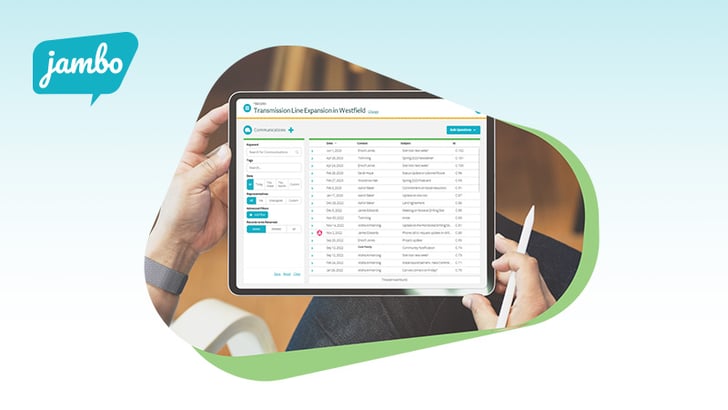
Jambo centralizes your stakeholder data, tracks every interaction, logs issues and commitments, and generates audit-ready reports, giving your whole team a shared, searchable record of your engagement history.
Jambo is particularly strong on:
- Creating stakeholder profiles with full interaction and issue history
- Commitments tracking tied to individual stakeholders
- Enabling team-wide access so the relationship context doesn't live in one person's inbox
- Reports that can be compiled in seconds rather than days
- Security and compliance features built for government and regulated industries
Example: A government infrastructure team we work with previously managed stakeholder data across 14 spreadsheets maintained by different team members. After moving to Jambo, they reduced their reporting time from 2 weeks to 2 hours and eliminated duplicate outreach — stakeholders were no longer contacted multiple times by different team members who didn't know someone had already been in touch.

Frequently Asked Questions (FAQs): stakeholder engagement tools
1. Do I need to replace my existing tools, or can SRM software work alongside them?
Most SRM platforms, including Jambo, are designed to work alongside your existing communication and project management tools rather than replace them. Your team continues to use email, Teams, or Slack for internal communication; the SRM is where stakeholder-facing interactions, records, and commitments are logged and tracked.
2. How long does it take to get up and running with SRM software?
This varies by platform and team size. Jambo is designed for fast onboarding with dedicated customer success support. Most teams are operational within a few weeks, with full adoption typically following within a quarter.
About the author
Chinenye Ozowara is the content marketing specialist for Jambo. With a strong background in business analysis, she excels at stakeholder communication and developing engagement strategies that strengthen relationships, build trust, and drive meaningful results for organizations.