The stakeholder management process involves nurturing relationships, balancing diverse interests, and actively communicating with those who may influence or be affected by your project. As a stakeholder manager or project manager, you manage evolving relationships, navigate conflicting priorities, and ensure everyone stays aligned with the project's vision.
Given these complexities, following a formal and systematic stakeholder management process is crucial. In this blog post, we'll explore the stakeholder management process, outline the four key phases of the stakeholder management process every stakeholder engagement manager should know, and highlight practical tools and techniques to help you successfully manage stakeholder relationships throughout your project lifecycle.
What is the stakeholder management process?
The stakeholder management process is a continuous, strategic effort to identify, analyze, and engage all individuals, groups, or organizations with an interest in or influence over a project or initiative. The goal is to build and maintain positive relationships, manage expectations, and foster cooperation to ensure the project's successful outcome. This proactive approach allows project managers to gain stakeholder buy-in, mitigate potential issues, and make more informed decisions by incorporating diverse perspectives throughout the project's lifecycle.
New to stakeholder management? This comprehensive guide provides a clear understanding →
4 phases of the stakeholder management process
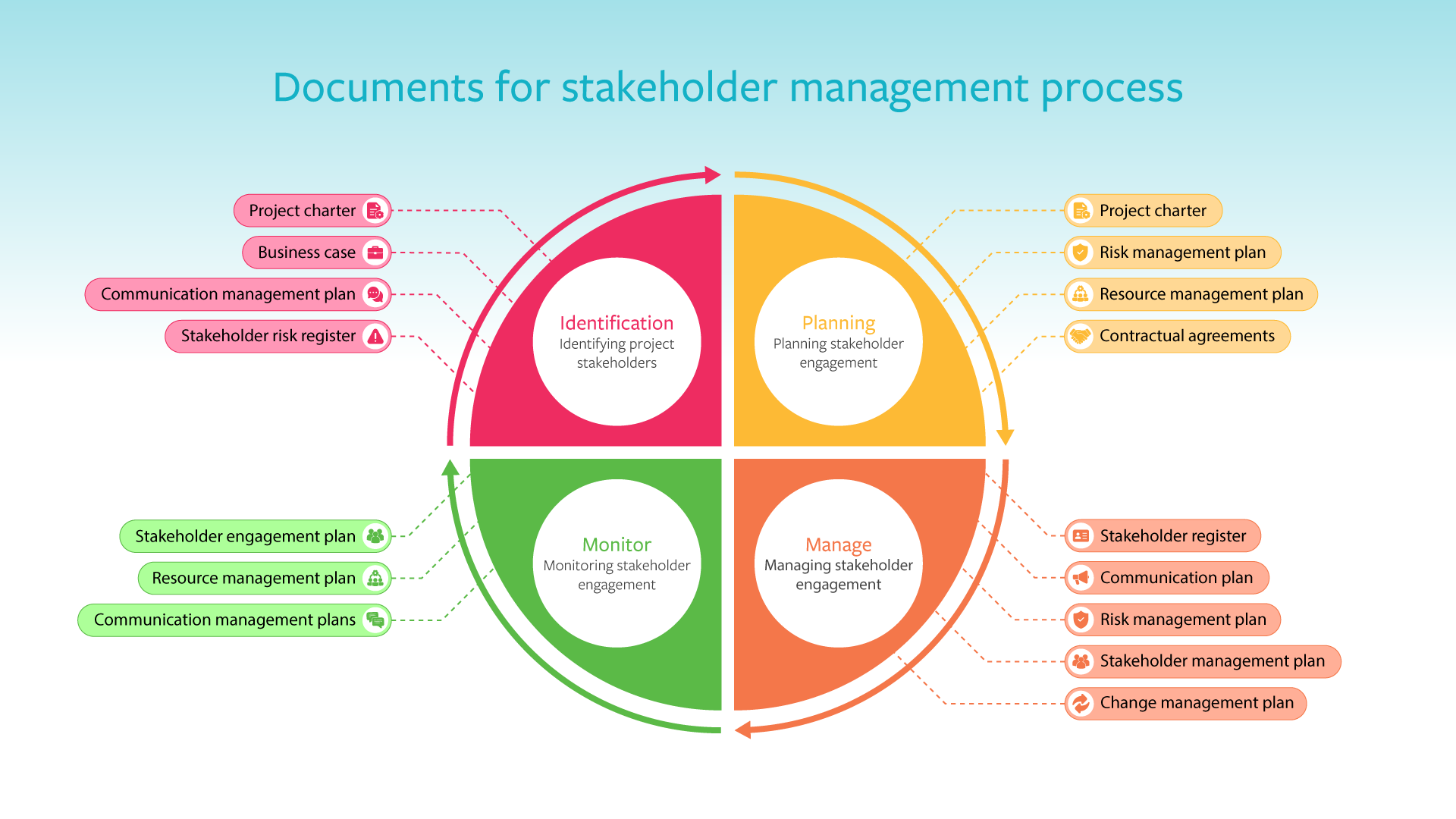
The stakeholder management process involves four phases: identifying stakeholders, planning stakeholder engagement, managing stakeholder engagement, and monitoring stakeholder engagement. From the project's initiation to its closing, following a step-by-step stakeholder management process ensures that all stakeholder needs and expectations are appropriately identified, analyzed, and addressed.
An effective stakeholder management process involves gathering information, planning communication, and continually adapting to feedback. It minimizes risks from potential opposition, leverages the support of key stakeholders, and fosters transparency to ensure successful project completion.
1. Identifying project stakeholders
Identifying project stakeholders is the first phase of project stakeholder management. It involves recognizing who your stakeholders are, what they care about, and their preferred communication methods. This can be performed periodically throughout the project as needed.
A project charter, a business case, and a communication management plan are some key documents that can help identify your stakeholders, whether in a simple or complex project.
- A project charter should include a list of primary or key stakeholders, outline project objectives, and identify who could be affected.
- A business case is used to secure approval and funding from stakeholders by clearly explaining why the project is necessary and how it will add value to the organization.
- A communication management plan is a document that lists and organizes the types, cadence, and expectations of communications.
Stakeholder identification and analysis
To identify your stakeholders, you can utilize tools and techniques such as stakeholder mapping using power-interest grids, stakeholder cubes, surveys, or focus groups. You will then analyze them to determine their priority (high or low interest and high or low power).
After identifying and analyzing your stakeholders, document their information in your stakeholder management tool. You can then create a stakeholder risk register. This document identifies and tracks risks associated with individual stakeholders and their relationship to a project. The register should contain information such as:
- Identification information: Names, organizational positions, contact details, and roles.
- Assessment information: Requirements, expectations, potential to influence project outcomes, and the project stage where they may have the greatest impact.
- Classification: Classify whether they are high or low impact and high or low priority. You will determine this during the stakeholder analysis.
By documenting this information, project managers can clearly understand the stakeholders essential to the project and who must be included in the stakeholder engagement plan.

2. Planning stakeholder engagement
The second key phase in the stakeholder management process is planning stakeholder engagement. The planning phase has only grown more critical as success metrics evolve. PMI's 2025 Pulse of the Profession found that 93% of project professionals prioritize stakeholder management when scope is under pressure, ahead of timeline management (89%), and 91% prioritize it when budgets tighten. Project managers who plan stakeholder engagement thoroughly at the outset tend to adapt far better when priorities inevitably shift mid-project
In the engagement stage, the project manager develops a stakeholder engagement strategy and an actionable implementation plan to involve stakeholders based on their interests, level of influence, expectations, and potential impact on the project's success. This helps ensure that each stakeholder is appropriately engaged throughout the project lifecycle.
Project managers can use resources such as a project charter, risk management plan, and resource management plan to develop a stakeholder engagement strategy. A risk management plan includes information on risk thresholds and suitable engagement strategies. A resource management plan outlines the roles and responsibilities of team members and other project stakeholders.
Other resources and tools for planning stakeholder engagement include contractual agreements, historical information, an assumption and constraint analysis, mind mapping, and a stakeholder engagement assessment matrix.
At the end of the second phase of the stakeholder management process, you should have a stakeholder engagement plan which outlines:
- Approaches: The methods you will use to engage each stakeholder or stakeholder group.
- Communication plan: The frequency, channels, and formats for stakeholder communications.
- Roles and responsibilities: Who is responsible for engaging identified stakeholders, and how will they document communications and feedback?
- Action plan: This includes steps to implement your strategy and move stakeholders from their current level of engagement to the desired one.
Learn more about planning your next online stakeholder engagement event from experts →
3. Managing stakeholder engagement
The third step in the stakeholder management process is managing stakeholder engagement. This phase focuses on actively engaging your stakeholders to inform them of project information and progress, address concerns, facilitate involvement, and nurture positive relationships.
With your stakeholder engagement plan developed, you can start engaging stakeholders, managing their expectations through communication and negotiations, and identifying and addressing potential concerns.
To successfully manage stakeholder engagement, you need the documents we previously mentioned, such as a stakeholder register, a communication plan, and a risk management plan. Additional documents that may be useful include a stakeholder management plan and a change management plan.
A stakeholder management plan provides guidance and information on handling stakeholder expectations, and a change management plan details the process for submitting, evaluating and implementing project changes.
Stakeholder management skills, including communication and interpersonal skills, are essential at this stage. Stakeholder satisfaction assessment tools are too. Surveys and feedback forms can measure stakeholder satisfaction to ensure you're on track. You can log stakeholder sentiment in your stakeholder management tool.
Moreover, many stakeholder management software solutions now include built-in AI to analyze sentiment in stakeholder communications, helping project managers detect shifts in support or concern before they escalate. AI adoption among professionals has reached a tipping point. Stanford's 2026 AI Index reports that 58% of employees globally now use AI at work on a regular or semi-regular basis, up sharply from prior years. For stakeholder managers, AI-assisted tools can surface risks in real time rather than during the next scheduled check-in, which matters when a small, unaddressed concern can harden into organized opposition within days.
What are some tips for managing stakeholder engagement?
- Implement your engagement plan: You made the plan, now stick to it, follow the strategies and actions in the plan and adjust based on feedback and project changes.
- Communicate early and regularly: Provide consistent, relevant updates to stakeholders and be receptive to their feedback.
- Assign responsibilities: Clearly define and delegate duties for managing stakeholder interactions and responding to issues.
- Document feedback and actions: Record all key communications, decisions, and actions related to stakeholder engagement for transparency and future reference.
- Proactive issue resolution: Address concerns as they arise, reducing disruptions and maintaining progress toward project objectives.
 4. Monitoring stakeholder engagement
Monitoring stakeholder engagement is the fourth key phase in the stakeholder management process. This phase focuses on continuously tracking stakeholder relationships and engagement efforts to ensure they remain effective and support project objectives throughout the project lifecycle.
This step ensures that the stakeholder engagement strategy achieves the desired outcomes and adjusts approaches in response to changes in stakeholder influence, feedback, or project requirements. It's essential to ensure stakeholders receive accurate information about the project and are involved at the correct times.
What to measure
Effective monitoring tracks a mix of activity, sentiment, and outcome metrics. High-performing project teams typically watch:
- Participation rate: the percentage of invited stakeholders who attend sessions, open communications, or interact with content
- Response time: how quickly your team addresses stakeholder inquiries, and how quickly they respond to yours
- Sentiment score: aggregated positive, neutral, and negative signals from surveys, emails, and meeting notes
- Feedback implementation rate: the ratio of stakeholder suggestions received to those actually acted upon
- Stakeholder NPS: an internal Net Promoter Score measuring how likely stakeholders are to recommend working with your project team
- Issue resolution speed: how quickly concerns move from raised to closed
These are leading indicators. A drop in participation or a dip in sentiment typically appears weeks before a stakeholder publicly withdraws support, giving you time to intervene.
The stakeholder engagement, resource, and communication management plans are among the documentation and resources needed during this step.
When your project ends, reflect on your stakeholder engagement strategy. Identify what went well and what could have been improved. Document key lessons learned for future projects. Another tip is always to remain appreciative of your stakeholders' willingness to participate and, if possible, let them know how their feedback was incorporated or influenced the project's outcomes.

What tools and techniques can you use in the stakeholder management process?
To support your stakeholder management efforts, consider utilizing these tools and techniques:
Documentation tools
- Stakeholder register: A central document that lists all identified stakeholders and relevant information about them (contact details, interest, influence, expectations, current level of support, etc.).
- Stakeholder analysis matrix: A table systematically documenting stakeholder needs, expectations, influence, and planned engagement strategies.
Visualization and prioritization tools
- Power-interest grid (and other stakeholder mapping techniques): Visual tools such as the Salience Model or the Influence/Impact Matrix can offer different lenses for identifying and classifying stakeholders.
- RACI matrix (Responsible, Accountable, Consulted, Informed): Useful for clarifying roles and responsibilities for project tasks and stakeholder involvement.
Communication and feedback tools - Communication plan: A detailed outline of communication strategies, channels, frequency, and responsibilities.
- Meetings and presentations: Essential for communicating information, building relationships, and facilitating discussions.
- Stakeholder management software: Jambo's stakeholder relationship management software can help track communications, tasks, and stakeholder engagement.
- Surveys and interviews: Formal and informal methods for gathering stakeholder feedback and understanding their perspectives.
You might also be interested in the frameworks and tools for managing stakeholder relationships →
Enhancing your stakeholder management process with Jambo
Improving your stakeholder management process can significantly improve project outcomes. Jambo offers a user-friendly platform designed to streamline tasks such as managing your stakeholder register, tracking your stakeholder communications and interactions, analyzing stakeholder sentiment, and managing tasks and responsibilities.
By simplifying these steps, Jambo helps support your efforts to build stronger stakeholder relationships, manage risks, and keep your projects moving forward. If you're interested in exploring how Jambo can fit into your workflow, consider setting up a discovery call to see its features in action.